
Fountain Square and Its Role in Downtown Cincinnati, Ohio
Cincinnati, Ohio has a civic heart that most residents and visitors encounter within their first hours in the city — Fountain Square, the open public plaza at the intersection of Fifth and Vine Streets in the center of downtown. This half-acre urban square, anchored by the Tyler Davidson Fountain that has stood at its center since 1871, functions as the primary gathering space for Hamilton County’s most populous city and as the symbolic center of a downtown that has undergone significant transformation over the past two decades.
For Cincinnati residents, downtown workers, and anyone tracking the evolution of Ohio’s third-largest city, understanding Fountain Square’s history and ongoing role in civic life provides essential context for appreciating what makes downtown Cincinnati distinct from other Midwest urban centers.
The Tyler Davidson Fountain: Origins and Civic Significance
The Tyler Davidson Fountain — formally titled The Genius of Water — was commissioned by businessman Henry Probasco as a memorial to his business partner and brother-in-law Tyler Davidson and cast in Munich, Germany by sculptor August von Kreling. Its arrival in Cincinnati in 1871 represented a significant civic investment in public art and urban beautification during a period when the city was one of the most important commercial centers in the American interior.
The fountain’s central figure — a female form with arms outstretched, water cascading from her fingertips — became one of the most recognized public sculptures in the Midwest and established the square’s identity as a place of civic meaning beyond its practical function as a pedestrian gathering point.
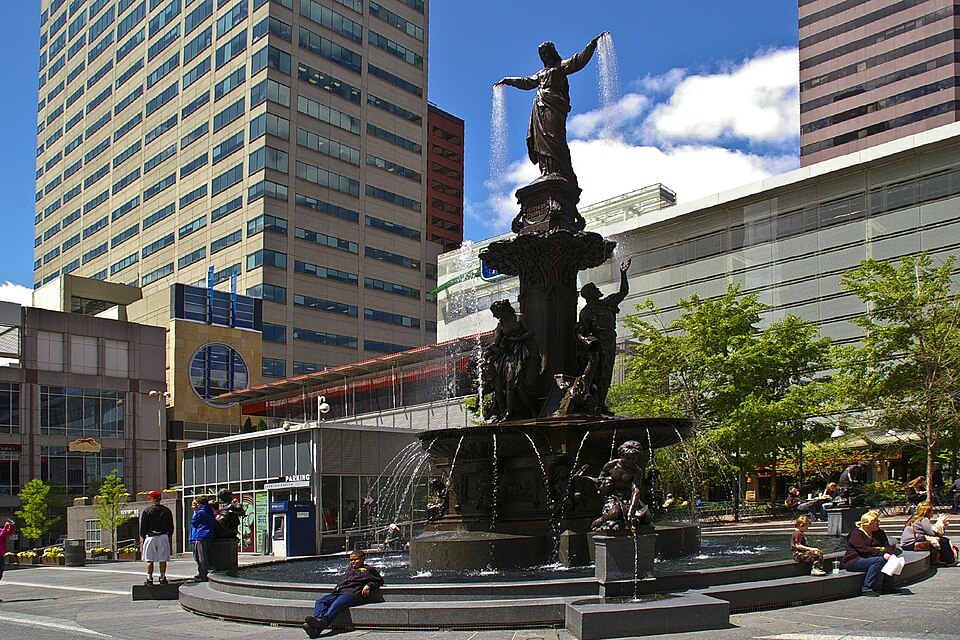
Image Credit: Niagara66, CC BY-SA 4.0, via Wikimedia Commons

The Square’s Architectural and Urban History
Fountain Square’s relationship to the surrounding urban fabric has evolved substantially since the fountain’s installation in 1871. The original square sat at street level, surrounded by the commercial buildings of Cincinnati’s Victorian-era downtown and connected directly to the street grid of Fifth Street.
Successive redesigns — including a major renovation in the 1970s that elevated the plaza above street level on a raised deck — changed the square’s relationship to pedestrian flow and surrounding retail, with mixed results that urban planners and city officials eventually recognized as barriers to the activation and accessibility that a successful public square requires.
The most significant transformation of the modern era came with the 2006 renovation project that restored Fountain Square to street level, relocated the Tyler Davidson Fountain to the center of the new plaza design, and created an events infrastructure — including a performance stage, ice skating rink, and flexible event space — that transformed the square from a passive pedestrian thoroughfare into an actively programmed civic venue.
This renovation, undertaken through a public-private partnership between the City of Cincinnati and corporate sponsor Fifth Third Bank, exemplifies the urban revitalization approach that the Project for Public Spaces — a nonprofit research organization focused on public space design — has documented as essential for transforming underperforming urban plazas into genuinely activated community destinations.
Seasonal Programming and Cincinnati’s Climate
Cincinnati’s climate shapes the programming calendar and physical character of Fountain Square in ways that are fundamental to how the space functions across the year. The city experiences a humid continental climate — characterized by hot, humid summers with average July highs near 86°F, cold winters with average January lows near 22°F, and the full seasonal range that defines Ohio’s weather patterns. According to NOAA climate data, Cincinnati averages approximately 42 inches of annual precipitation and receives measurable snowfall between November and March.
This seasonal range drives a programming strategy that adapts the square to each season’s conditions. The ice skating rink — installed each winter on the square’s central plaza — draws downtown workers, families, and visitors to the space during the months when outdoor activity in Cincinnati requires the incentive of a structured activity and a warming amenity.
Summer programming focuses on outdoor concerts, food festivals, and the open-air gatherings that Cincinnati’s warm season supports, while the shoulder seasons of spring and fall bring their own programming cycles tied to regional events and the Cincinnati Reds and Bengals seasons that animate downtown’s sports tourism calendar.
Cincinnati’s green spaces reinforce the seasonal outdoor culture that makes the city’s public realm appealing year-round. The Cincinnati Zoo and Botanical Garden and the historic landscapes of Eden Park represent the broader network of civic green spaces that complement Fountain Square’s downtown role — together forming a system of public destinations that sustains resident engagement with the city’s outdoor amenities across every season.
Fountain Square as an Economic Anchor for Downtown Cincinnati
The economic impact of Fountain Square on surrounding downtown Cincinnati extends well beyond the square itself. The concentration of office towers, hotels, and retail establishments within a two-block radius of the square — including the Fifth Third Center, the Carew Tower, and the 21c Museum Hotel — reflects the established commercial geography of downtown Cincinnati’s core and the sustained investment that the square’s civic anchor function has supported.
The Cincinnati Center City Development Corporation (3CDC), the nonprofit development organization that manages Fountain Square’s programming and physical maintenance, publishes data on the square’s event attendance and economic activity that documents its role as one of the most significant drivers of downtown foot traffic in Hamilton County.
The square’s programming calendar generates measurable economic activity for the restaurants, bars, and retailers that line the surrounding blocks. Major events — the Cincinnati Music Festival, which draws visitors from across the Midwest; holiday lighting ceremonies; and the summer concert series — convert the square’s civic function into direct consumer spending that supports the downtown businesses that benefit from the pedestrian activity these events generate.