
Wright-Patterson Air Force Base: Dayton’s Aviation Legacy
Dayton, Ohio holds a unique distinction in American history: it is the birthplace of powered flight. Orville and Wilbur Wright, who ran a bicycle shop just miles from what is now Wright-Patterson Air Force Base, conducted their early aeronautical experiments in the Miami Valley before their famous 1903 flights at Kitty Hawk, North Carolina. The Wright brothers returned to Dayton after that breakthrough, and a local flying field — known as Huffman Prairie — became the site of the world’s first practical airplane, perfected through hundreds of flights between 1904 and 1905.
Huffman Prairie Flying Field is now a federally protected historic managed by the National Park Service as part of the Dayton Aviation Heritage National Historical Park. It sits entirely within the boundaries of Wright-Patterson Air Force Base, making the installation not just a working military base but an active steward of American aviation heritage.
For residents of the greater Dayton area, the base is more than a landmark — it is a living institution woven into the region’s economy, identity, and daily life. That same civic pride shapes how Daytonians care for their communities, from historic neighborhoods like the Oregon District to the green corridors that run through the city’s parks and yards.
A Brief History of the Installation
The land that became Wright-Patterson has served military aviation purposes since World War I. Wilbur Wright Field was established in 1917 on the eastern edge of Dayton to train military pilots, and Fairfield Air Depot was created nearby to support aircraft maintenance and supply. After Orville Wright and businessman Edward Deeds donated land, McCook Field — used for early Army aviation research — was consolidated with these installations over subsequent decades.
In 1948, following the death of General Frank Patterson, a World War I aviator and Dayton native, the two adjacent fields were formally merged and renamed Wright-Patterson Air Force Base. The dual name honors both the Wright brothers and the Patterson family, reflecting the deep entanglement between Dayton’s civic history and its military aviation heritage.
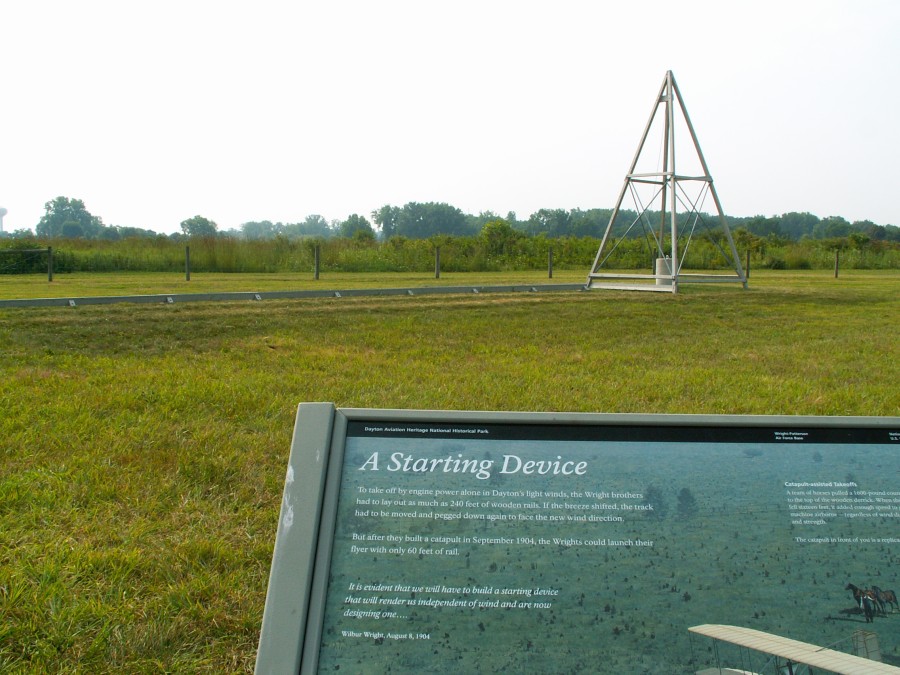
Image Credit: K. Shimada, CC BY-SA 3.0, via Wikimedia Commons

Today, Wright-Patterson spans more than 8,000 acres across two distinct areas — Area A and Area B — making it one of the largest Air Force installations in the United States by land area. It employs more than 27,000 military and civilian personnel, according to the base, making it the single largest employer in the state of Ohio.
Research, Innovation, and the Air Force Research Laboratory
A National Hub for Aerospace Science
Wright-Patterson is home to the Air Force Research Laboratory (AFRL), the primary scientific research and development organization for the U.S. Air Force and Space Force. The AFRL conducts and funds research across a range of disciplines — including aerospace systems, directed energy, materials and manufacturing, sensors, and human performance. Much of the technology that has shaped modern aviation, from stealth materials to advanced navigation systems, traces roots to research conducted here in the Miami Valley.
The concentration of federal research dollars in Dayton has driven a broader innovation ecosystem throughout the region. Universities including the University of Dayton, Wright State University, and the Air Force Institute of Technology — which operates directly on base — collaborate with AFRL on programs that move research from laboratory to application. According to the Dayton Development Coalition, the base generates an estimated $4 billion in annual economic impact for the surrounding region.
The Air Force Institute of Technology
The Air Force Institute of Technology (AFIT), located within Wright-Patterson, serves as the Air Force’s graduate school of engineering, science, and management. It awards advanced degrees to active-duty military officers and Department of Defense civilians in fields ranging from aeronautics to cyber operations. AFIT’s presence reinforces Dayton’s reputation as a center for high-technology education and workforce development — a distinction that supports property values and professional growth across the metro area.
The National Museum of the U.S. Air Force
Adjacent to Wright-Patterson’s main gate stands the National Museum of the United States Air Force — the world’s largest aviation museum and one of the most-visited free attractions in Ohio. The museum houses more than 350 aerospace vehicles and missiles displayed across four enormous hangars, tracing the full arc of powered flight from the Wright brothers’ Flyer to modern stealth aircraft and space systems.
Admission is free, and the museum draws more than one million visitors annually from across the country and around the world. For Dayton-area residents, it serves as both a cultural institution and a direct connection to the history that unfolded in their own backyards. The museum is operated by the Air Force Material Command and supported by the Air Force Museum Foundation, a nonprofit organization.
Exhibits cover virtually every era of American air power — from World War I biplanes to Cold War bombers to prototype aircraft that never reached full production. The Presidential Aircraft Gallery, which houses Air Force One planes that carried multiple U.S. presidents, is among the most popular permanent collections.
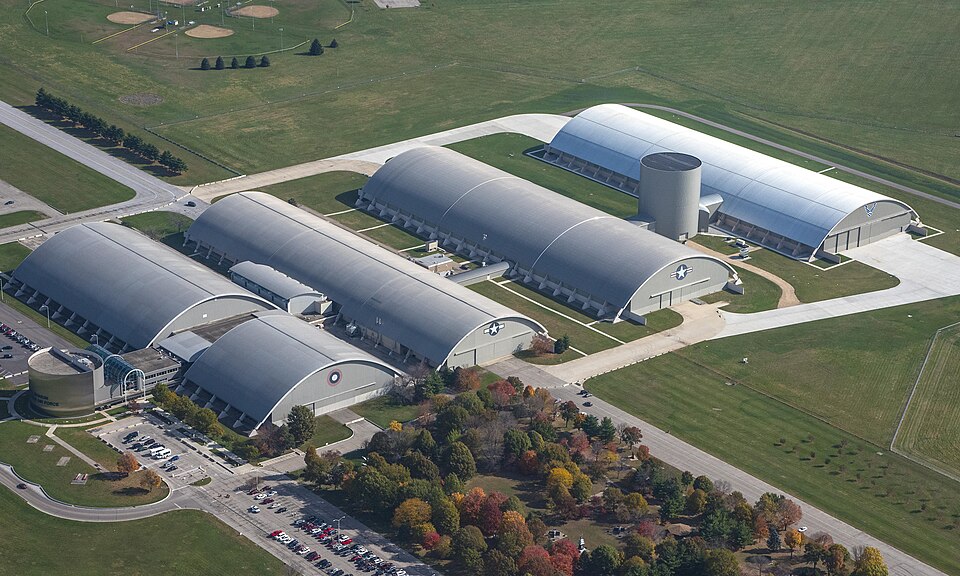
Image Credit: NMUSAF, CC BY-SA 4.0, via Wikimedia Commons

Economic and Community Impact on the Dayton Region
Wright-Patterson’s influence extends well beyond its fences. The base anchors a defense and aerospace industry cluster that includes hundreds of contractors, suppliers, and technology firms throughout the Miami Valley. Montgomery, Greene, and Clark counties all host businesses with significant ties to base contracts and AFRL programs.
This concentration of federal employment provides economic stability that buffers the Dayton region against broader economic cycles. Government employment at Wright-Patterson continued during periods when the region’s manufacturing base was contracting — offering consistent demand for housing, services, and infrastructure in communities like Beavercreek, Fairborn, Yellow Springs, and Kettering.
The base also contributes to the region’s green space and natural character. Huffman Prairie, the Wright brothers’ original test field preserved within the installation’s boundaries, is managed as a native tallgrass prairie — one of the few intact examples of this once-dominant Ohio ecosystem. The prairie’s seasonal cycles connect naturally to Dayton’s broader network of natural areas, including the trails and greenways maintained by Five Rivers MetroParks, which preserves tens of thousands of acres across the Miami Valley.
That same climate — long growing seasons, abundant summer rainfall averaging around 40 inches annually, and clay-heavy soils common throughout the Miami Valley — shapes the lawns and landscapes surrounding the thousands of homes in communities near the base. Residents from Beavercreek to Huber Heights experience the same regional conditions that have influenced land management at Huffman Prairie for over a century.