
Is Lawn Treatment Safe for Dogs and Kids?
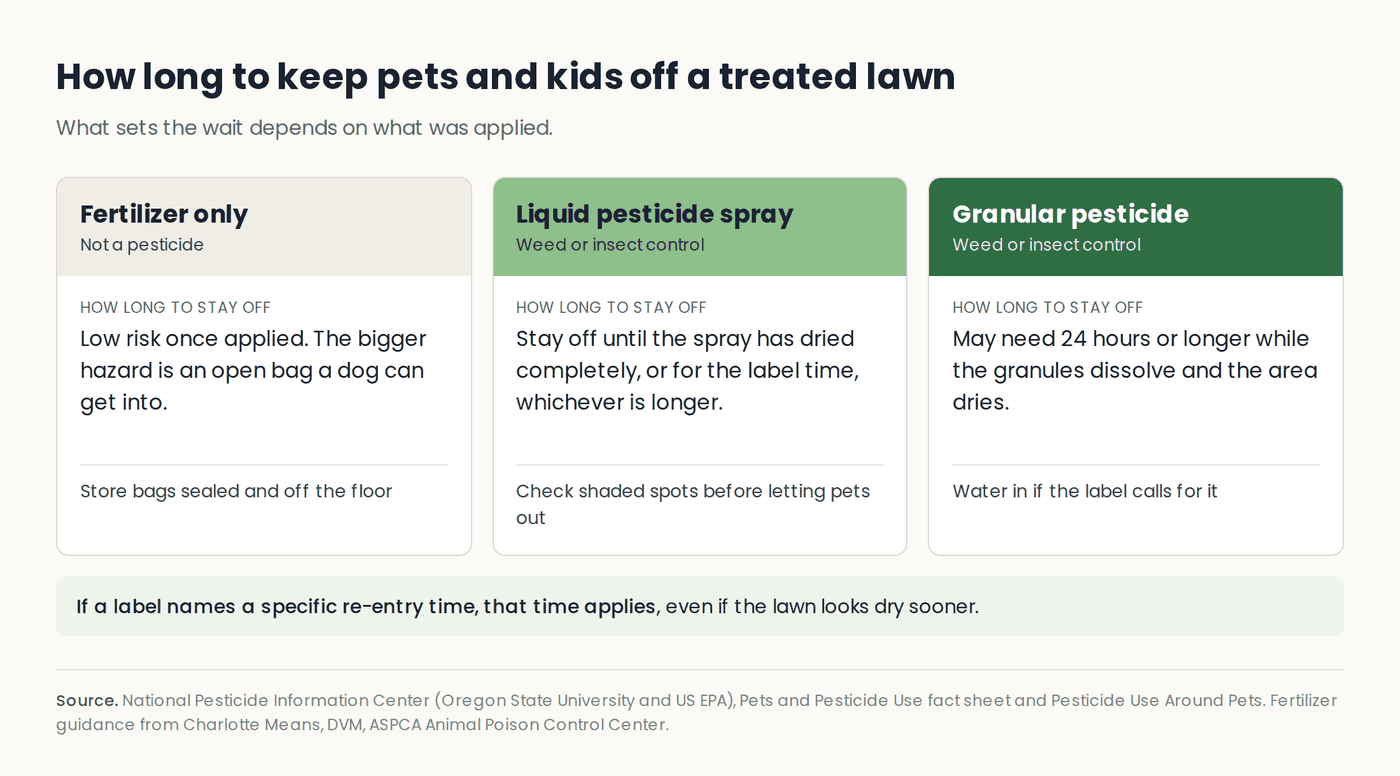
Usually yes, once the product has settled in and the lawn is dry, but the answer depends on what was applied. Fertilizer on its own is low risk. Weed and insect controls are pesticides, and the National Pesticide Information Center’s rule is to keep pets away until sprays have dried completely or for the time on the label, whichever is longer. Granular pesticide products can need 24 hours or more.
That short answer hides the part most people are really asking about: what is in the treatment, how long to wait and why, what the small sign on the lawn means in Ohio, and what to do if a dog eats something it should not have. Each is covered below, with the source for every figure.
Jump to: What is in a lawn treatment · How long to stay off · The lawn sign in Ohio · Dogs specifically · Children · If exposure happens · Organic and natural · Questions to ask · FAQ
What is actually in a lawn treatment
“Lawn treatment” covers two very different kinds of product, and the safety question is different for each.
- Fertilizer feeds the grass. It supplies nitrogen, phosphorus, potassium and sometimes iron. Fertilizer is not a pesticide.
- Pesticides control something. On lawns that usually means herbicides for weeds, insecticides for grubs and other insects, and occasionally fungicides for disease.
Many retail and professional products combine the two, such as a weed and feed. The ASPCA Animal Poison Control Center points out that a fertilizer label may list “an herbicide, insecticide, fungicide, or combination thereof,” and each of those ingredients has to be considered on its own. The first question to ask about any visit is therefore not “is it safe” but “was a pesticide applied today, and which one.”
The National Pesticide Information Center, run by Oregon State University in cooperation with the EPA, frames risk with a simple equation: “Toxicity x Exposure = Risk.” It is also direct that “every pesticide is toxic if the exposure level is high enough. Therefore, no pesticide is entirely safe.” What changes the risk for a household is mostly exposure, and exposure is what the waiting period controls.
How long pets and children should stay off
The National Pesticide Information Center gives one rule that covers most situations: “Keep pets away from treated areas for the amount of time specified on the pesticide label or until any sprayed pesticides have dried completely, whichever is longer.”
Liquid sprays
For sprayed products, drying is the key event. Sun and a breeze speed it up. A cool, humid morning or a shaded corner of the lawn slows it down considerably. Checking the grass by hand on a few spots, including shaded ones, is more reliable than checking the clock.
Granular products
Granules take longer. The Center notes that granular lawn products “may require keeping the pets off the treated area for 24 hours or longer while the granules dissolve and the treated area dries.” Many granular labels also call for watering the product in. According to the Center, dissolving the granules “helps to prevent granules from getting trapped in pet fur or eaten by birds.”
The label decides
Under federal law, the label is the instruction for every registered pesticide. If a label names a specific re-entry time, that time applies even if the lawn looks dry sooner. The EPA’s consistent advice to homeowners is to read the label first, and a professional applicator should be able to say exactly what the label for that day’s product requires.
What the small sign on the lawn means in Ohio
Ohio has a specific rule for this. Ohio Administrative Code 901:5-11-09 sets notification requirements for commercial lawn pesticide applicators, and it explains the small sign that appears after some treatments.
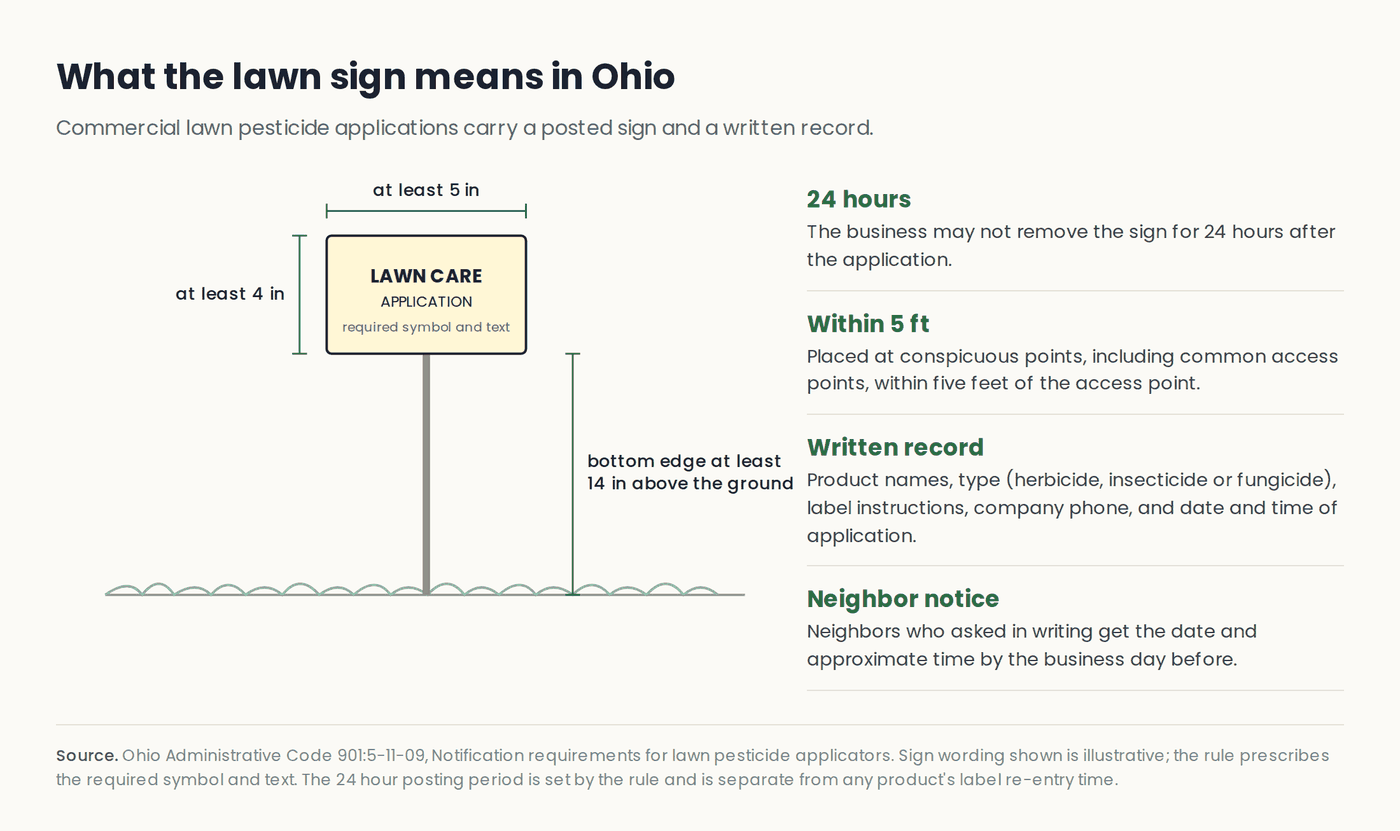
- Size and height: the sign must be at least five inches by four inches, on a support that holds its bottom edge at least fourteen inches above the ground.
- Placement: at conspicuous points, including common access points, within five feet of the access point.
- Duration: the rule states that the business shall not remove the signs “for twenty-four hours following lawn pesticide application.”
- Written information for the customer: provided before or at the time of application, including the brand or common name of each pesticide, whether it is a fungicide, herbicide or insecticide, the label instructions that apply to the customer, the company’s name and phone number, and the date and time of application.
- Neighbor notice: neighbors who have asked in writing must be offered advance notice of the application date and approximate time, on or before the business day before.
Two practical points follow. First, the sign marks a pesticide application. A fertilizer only visit does not carry the same requirement. Second, the 24 hours is the required posting period, not a statement about how long any particular product needs. The product’s own waiting time is on its label, and the written information left after the visit is where to find it.
Dogs specifically: paws, grass and bags
Dogs spend more time nose down on the lawn than anyone else in the house, so they get their own section.
Walking on a treated lawn
The ASPCA Animal Poison Control Center’s director of toxicology, Dr. Charlotte Means, writes that when granules are on a lawn, “it is highly unlikely that a significant ingestion will occur if pets lick their paws after contact with treated lawns.” Waiting for granules to be watered in and for sprays to dry lowers that exposure further. A quick paw wipe after walks during treatment weeks is an easy extra step.
Eating grass, granules or fertilizer
Dr. Means reports that small fertilizer ingestions cause anything from “no clinical signs to vomiting, diarrhea, hypersalivation, and lethargy,” and that “granular fertilizers rarely cause more than mild, self-limiting gastrointestinal upset.” Two exceptions are worth knowing:
- Bone meal, blood meal and fish meal. These are organic fertilizer ingredients that dogs find appealing. According to the same source, “extremely large ingestions of blood meal, bone meal, or fish meal may trigger pancreatitis in predisposed dogs,” and gorging on them can cause bloat. The risk is mainly from a dog getting into an open bag, not from a treated lawn.
- Iron. Fertilizers with more than 1 percent iron carry some toxicity risk, although Dr. Means notes that poor absorption usually prevents serious poisoning.
The simplest control is storage. Bags kept sealed and off the garage floor remove most of the risk.
What research says about herbicides and dogs
The most cited study is a Purdue University case control study published in the Journal of the American Veterinary Medical Association in 2004. Researchers compared 83 Scottish Terriers with bladder cancer against 83 Scottish Terriers with other conditions. Exposure to lawns or gardens treated with phenoxy herbicides, a common class of broadleaf weed killer, was associated with higher odds of bladder cancer (odds ratio 4.42). Exposure to insecticides alone was not significantly associated (odds ratio 1.62).
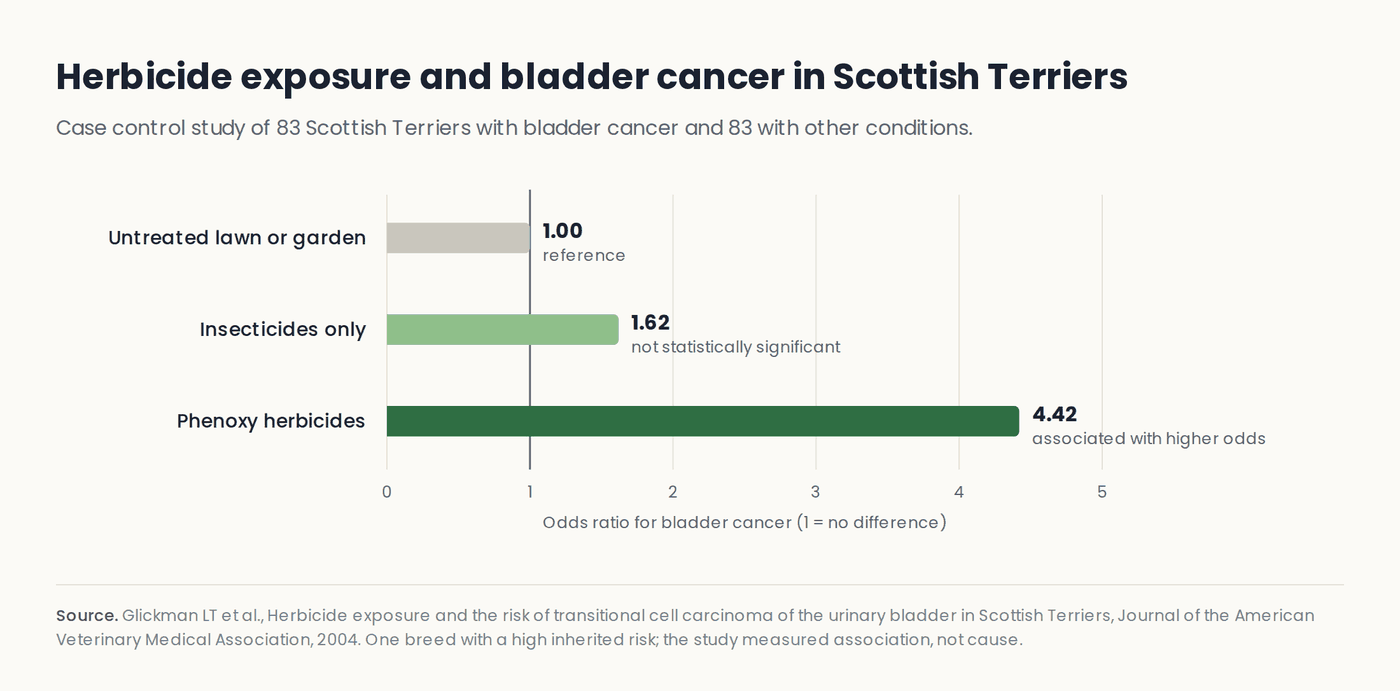
This study has limits that matter. It covered one breed that already carries a high genetic risk of this cancer, it measured association rather than cause, and it relied on owner reported exposure. The researchers’ own recommendation was that owners of Scottish Terriers “should minimize their dogs’ access to lawns or gardens treated with phenoxy herbicides.” Many dog owners of other breeds reasonably choose to apply the same caution, which usually means asking whether weed control is sprayed across the whole lawn or only on the weeds that are present.
If dogs also leave brown patches on the grass, that is a separate issue caused by urine rather than by any treatment. The guide to dog urine spots explains why it happens and how to fix it.
Children
The same waiting rules apply to children, with two additions. The National Pesticide Information Center advises to “keep children away from treated pets until the product has dried,” since a dog that walked through a wet spray can carry it indoors. Toys, balls and play equipment left on the lawn should be moved before a visit rather than after. The EPA also recommends keeping the Poison Control number, 1-800-222-1222, where anyone in the house can find it.
What to do if a pet or child is exposed
- Move them off the treated area and rinse skin, paws or fur with water if product is visible.
- Find the product name. In Ohio, the written information left by a commercial applicator names each pesticide. For store bought products, keep the bag or bottle.
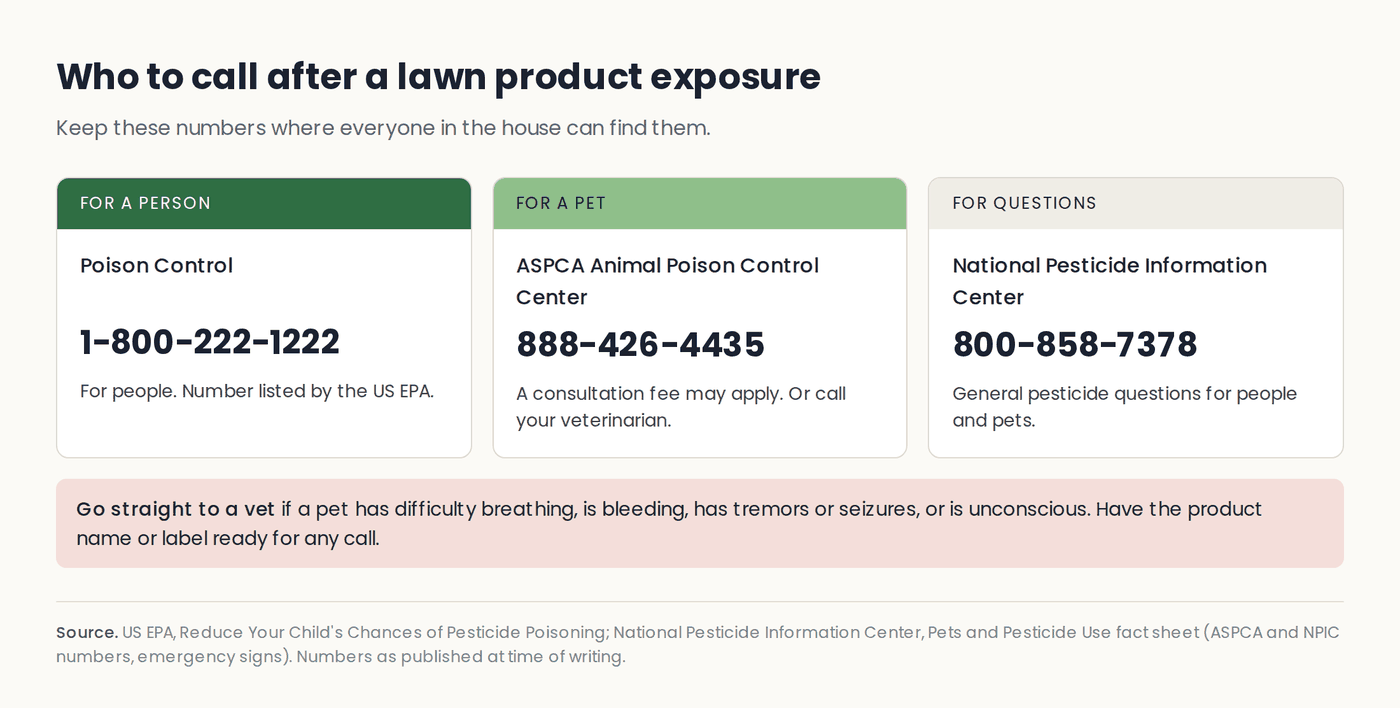
- For a person, call Poison Control at 1-800-222-1222.
- For a pet, call a veterinarian or the ASPCA Animal Poison Control Center at 888-426-4435. A consultation fee may apply. The National Pesticide Information Center, at 800-858-7378, answers general questions.
- Go straight to a vet if a pet is having difficulty breathing, is bleeding, has tremors or seizures, or is unconscious. That is the Center’s own emergency list.
Do “organic” and “natural” mean safe?
Not automatically. The National Pesticide Information Center explains that “natural” only means “the product’s ingredients are not man-made,” and adds that “some of the most toxic substances on earth are natural, such as snake venom, ricin, and arsenic.” “Green” has no regulatory definition at all. “Organic” does have a standard under the USDA National Organic Program, but the Center still cautions that “just because a pesticide is organic, does not mean that it is 100% ‘safe.'”
Two things are more useful to check than the marketing term:
- The signal word on the label. According to the Center, “a signal word of CAUTION indicates the lowest hazard level.” WARNING and DANGER indicate higher hazard.
- Whether a pesticide is being applied at all. A program that feeds the lawn with organic fertilizer and applies no pesticide removes the pesticide question entirely. A program that spot treats only the weeds present uses far less product than one that sprays the whole lawn. Either way, fertilizer ingredients such as bone or blood meal are still worth keeping away from dogs in bag form.
Questions to ask any lawn care company
- What exactly is being applied on this visit, and is any of it a pesticide?
- Is weed control sprayed across the whole lawn or only on weeds that are present?
- What does the label say about re-entry for today’s product?
- Will granular products be watered in, or should the homeowner do it?
- Can the company give notice before each visit so pets and toys can be brought in?
- Will the written application information be left at the door or sent by email?
A company that answers these clearly and without hesitation is usually one that takes the question seriously. More background is in why organic lawn care and the natural weed control article. For Ohio’s licensing side of the picture, see Ohio pesticide licensing, Ohio pesticide law in Cincinnati and pesticide safety compliance in Dayton.
Frequently asked questions
How long after lawn treatment can dogs go outside?
For a fertilizer only visit, the wait is short. For a liquid pesticide, until the spray has dried completely or the label time, whichever is longer. For a granular pesticide, the National Pesticide Information Center says 24 hours or longer may be needed while granules dissolve.
Can my dog get sick from walking on a treated lawn?
Serious illness from walking on a dried or watered in lawn is unlikely. The ASPCA Animal Poison Control Center states that a significant ingestion from paw licking after contact with granule treated lawns is highly unlikely. Waiting for the product to dry or dissolve lowers exposure further.
Is lawn fertilizer toxic to dogs?
Most lawn fertilizer causes mild stomach upset at most if eaten. Large amounts of bone meal, blood meal or fish meal can trigger pancreatitis or bloat in some dogs, so bags should be stored sealed and out of reach.
What does the lawn care sign mean in Ohio?
It means a commercial applicator applied a lawn pesticide. Ohio Administrative Code 901:5-11-09 requires the sign to stay up for 24 hours. The product’s own waiting time is on its label and in the written information the applicator must provide.
Is organic lawn care safe for pets?
A program that uses organic fertilizer and no pesticides removes the pesticide exposure question. “Organic” or “natural” on a pesticide label does not by itself mean it is safe, so the label and its signal word are still the thing to check.
Lawn care in Cincinnati and Dayton built around this question
PureLawn runs two lawn treatment programs. The PureGreen program is 100 percent pesticide free, using custom blended organic fertilizers made from vegetable by-product, and PureLawn’s own guidance is that children and pets can be back on the lawn right after the visit. The Bridge program uses organic based fertilizer and spot treats weeds instead of spraying the whole lawn. For Bridge visits, PureLawn asks that children and pets stay off the lawn for at least 3 to 4 hours and recommends 24 hours where possible. The details are in the PureLawn FAQs and what makes PureLawn different.
PureLawn serves Blue Ash, Montgomery, Kenwood, Madeira, Indian Hill, Wyoming, Dry Run and communities across the Cincinnati and Dayton areas. To talk through what a program would apply on a lawn shared with kids and dogs, contact PureLawn or call (937) 703-1221.
Sources
- National Pesticide Information Center, Pets and Pesticide Use Fact Sheet and Pesticide Use Around Pets.
- National Pesticide Information Center, Is It Safe? and Natural or Green? What Does It Mean.
- Ohio Administrative Code, 901:5-11-09, Notification requirements for lawn pesticide applicators.
- Charlotte Means, DVM, ASPCA Animal Poison Control Center, Treating Fertilizer Ingestions? As Easy As N-P-K, Today’s Veterinary Practice.
- Glickman LT et al., Herbicide exposure and the risk of transitional cell carcinoma of the urinary bladder in Scottish Terriers, Journal of the American Veterinary Medical Association, 2004, and Purdue University news release.
- US Environmental Protection Agency, Reduce Your Child’s Chances of Pesticide Poisoning and Lawn and Garden.