
University of Dayton’s Place in the Local Community in Ohio
Dayton, Ohio is a mid-sized Midwest city with a higher education landscape that punches well above its population weight, and no institution embodies that distinction more fully than the University of Dayton. Founded in 1850 by the Society of Mary — a Catholic religious congregation also known as the Marianists — the University of Dayton has grown from a small regional college into a nationally ranked research university that enrolls approximately 12,000 students and employs thousands of faculty and staff across a campus that occupies the southern edge of the city’s urban core.
For Montgomery County residents, Dayton homeowners, and anyone tracking the relationship between higher education and urban vitality, the University of Dayton’s community role is one of the most consequential institutional stories in southwest Ohio.
Founding and Community Presence
The university’s campus sits in the Caldwell Street neighborhood, directly south of downtown Dayton and adjacent to the Great Miami River corridor — a geographic position that places it at the intersection of the city’s residential, recreational, and commercial geographies. This location is not merely logistical; it reflects a deep institutional commitment to Dayton that has shaped how the university has approached its civic role across generations of leadership.
The University of Dayton is one of the largest private employers in the Dayton metropolitan area, and its economic footprint — through direct employment, student spending, real estate investment, and research activity — extends well beyond the campus boundaries into the neighborhoods and commercial corridors that surround it. Residents looking for a broader overview of what defines life and community in this part of Ohio can explore Dayton Ohio’s neighborhoods and amenities as context for understanding how the university fits within the city’s larger civic geography.
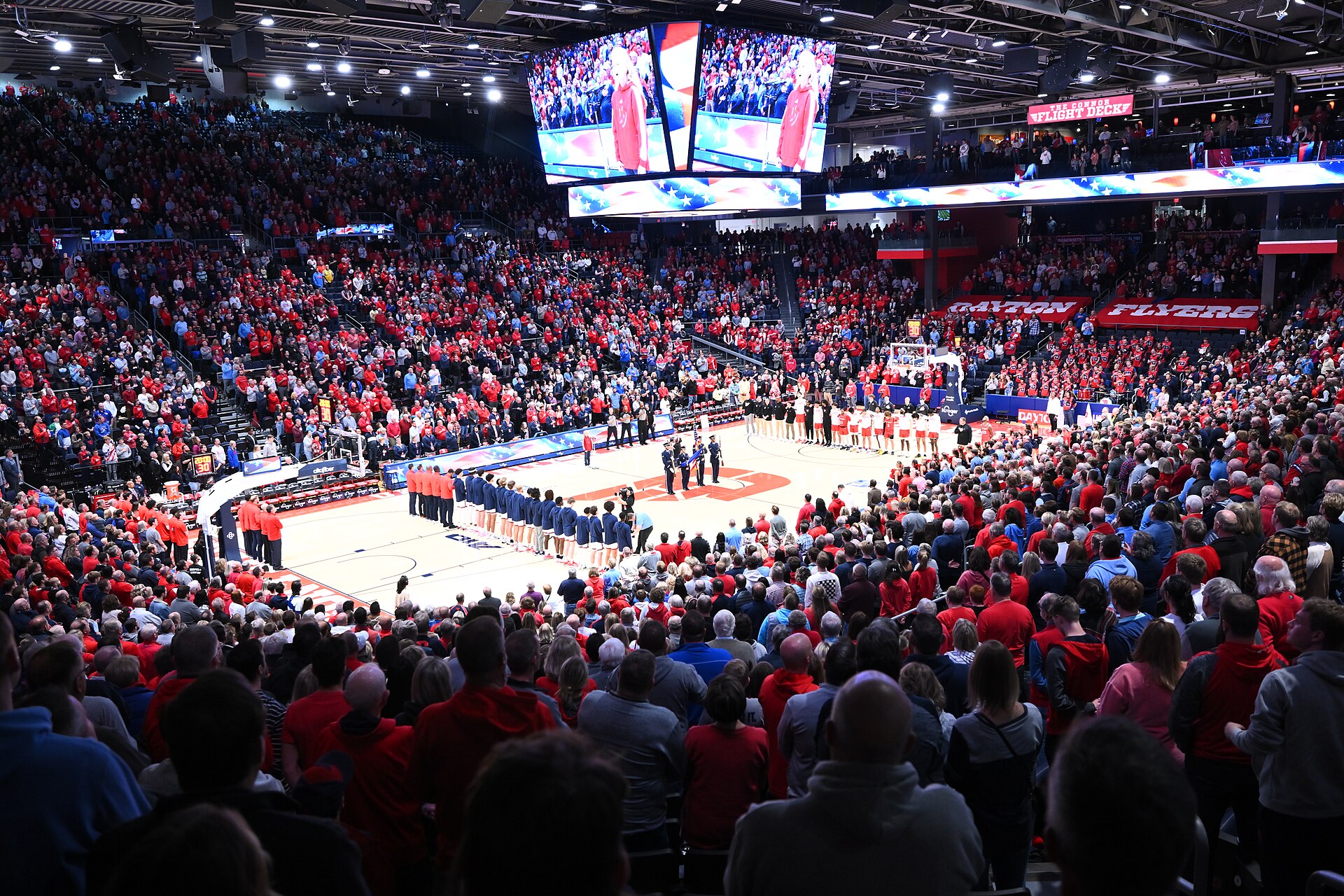
Image Credit: UDArena1969, CC0, via Wikimedia Commons

Academic Programs and Research Contributions
The University of Dayton’s academic profile spans undergraduate, graduate, and professional programs across the natural sciences, engineering, business, education, law, and the liberal arts — a breadth that reflects both the institution’s Catholic intellectual tradition and its sustained investment in applied research that serves the needs of the Dayton region’s economy. The university’s research enterprise has grown significantly over the past two decades, with sponsored research funding supporting programs in materials science, renewable energy, cybersecurity, and engineering that connect directly to the defense and aerospace industries concentrated in the Dayton metropolitan area.
The University of Dayton Research Institute (UDRI) — a separate but affiliated research organization that conducts contract research for government and industry clients — is one of the largest university-affiliated research centers in Ohio and a significant presence in the federal defense research ecosystem centered on Wright-Patterson Air Force Base in neighboring Fairborn. UDRI’s work in structural materials, nondestructive evaluation — the inspection of materials and structures without causing damage — and survivability research has made the University of Dayton a recognized partner for federal agencies and defense contractors operating in the Dayton corridor.
The University of Dayton Research Institute maintains publicly accessible documentation of its research programs and capabilities that reflects the scale and scope of this institutional research enterprise.
The University’s Neighborhood Investment and Urban Engagement
The University of Dayton’s relationship to its surrounding neighborhoods represents one of the most deliberate and sustained examples of anchor institution engagement in Ohio’s higher education landscape. Anchor institutions — universities, hospitals, and other large nonprofits whose physical presence is tied to a specific place — have been recognized by urban development researchers as critical partners in neighborhood revitalization because their long-term presence and economic resources create opportunities for investment that private market actors often cannot or will not undertake independently.
The university’s neighborhood investment activity in Dayton has included the acquisition and rehabilitation of residential properties in the adjacent neighborhoods, the development of student housing that replaced deteriorating housing stock, and commercial investment along the Brown Street corridor that has transformed a formerly underperforming commercial strip into one of Dayton’s most active independent retail and restaurant districts.
The Oregon District — Dayton’s oldest historic neighborhood just north of the university’s influence zone — shares this same pattern of community investment and independent commercial character, reflecting how multiple institutions and community stakeholders have contributed to the revitalization of Dayton’s urban core over the past two decades. Dayton’s climate shapes the practical dimensions of this neighborhood investment in specific ways.
Montgomery County experiences a humid continental climate — with average January lows near 20°F, July highs averaging around 84°F, and approximately 38 inches of annual precipitation according to NOAA climate data — that creates demanding maintenance cycles for the residential and commercial properties the university manages in its surrounding neighborhoods. Ohio’s freeze-thaw cycles, spring flooding potential along the Great Miami River corridor, and the seasonal lawn and landscape maintenance demands of a densely built neighborhood environment all factor into the operational costs of the university’s neighborhood portfolio.
Athletics, Campus Life, and Regional Identity
The University of Dayton’s athletic programs — particularly its men’s basketball team, which competes in the Atlantic 10 Conference and has produced one of the most sustained records of NCAA tournament appearances among mid-major programs nationally — have made the university a source of regional identity and civic pride that extends well beyond the campus community. UD Arena, the on-campus arena that serves as the home of Dayton Flyers basketball, regularly sells out for home games and hosts the NCAA tournament’s First Four rounds, drawing tens of thousands of visitors to Dayton each March and generating significant hotel, restaurant, and retail activity across Montgomery County.
Image Credit: Sbettin, CC BY-SA 4.0, via Wikimedia Commons

This athletic identity connects the university to a broad base of Dayton-area residents who may have no direct academic or employment relationship with the institution but follow its teams and take pride in its national profile. The Flyers’ consistent tournament presence has given Dayton a level of national sports media visibility that few cities of comparable size achieve — a form of place marketing that benefits the broader Dayton brand and contributes to the city’s efforts to attract residents, businesses, and investment.
Campus life at the University of Dayton extends the institution’s community impact through cultural programming, performing arts, public lectures, and community service initiatives that engage residents across Dayton and the surrounding Miami Valley region. The university’s commitment to community-engaged learning — a pedagogical approach in which students apply academic work to real community challenges — creates sustained connections between the campus and the nonprofits and civic organizations that define Dayton’s community sector.
The University of Dayton’s Role in Dayton’s Future
The University of Dayton occupies a position in Dayton’s civic landscape that has become more rather than less important as the city has navigated the economic and demographic challenges that have affected many Midwest manufacturing cities over the past four decades.
As Dayton’s population has declined from its postwar peak and its manufacturing base has contracted, the university has emerged as an increasingly central anchor for economic activity, talent retention, and neighborhood quality in a city that depends on its institutional sector to support functions that private markets alone cannot sustain. Dayton’s outdoor infrastructure reinforces the quality of life that supports resident and student retention — the Five Rivers MetroParks system provides Montgomery County residents with an extensive network of green spaces, trails, and river access that complements the urban amenities concentrated around the university campus and the surrounding neighborhoods.
For residents of Dayton and Montgomery County, the University of Dayton represents both a practical economic asset — an employer, a housing market stabilizer, a driver of commercial activity — and a civic institution whose values and long-term presence contribute to the character of a city working to define its identity and trajectory in the twenty-first century.