

When to Aerate Your Lawn in Ohio
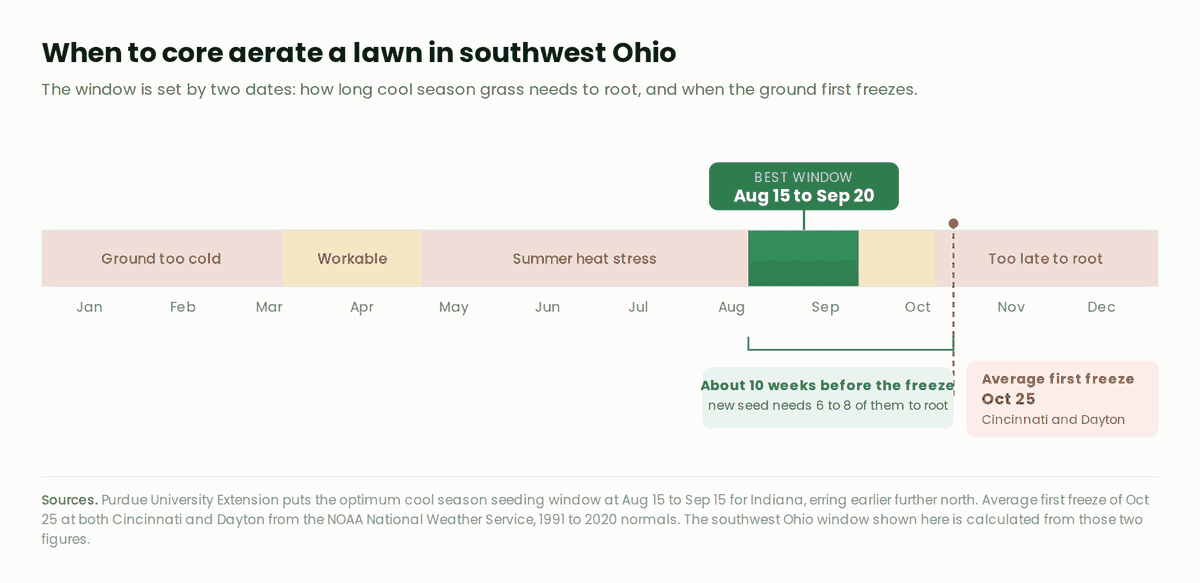
In southwest Ohio, core aerate your lawn between mid August and late September. That is the window when cool season grass is growing hardest, soil is still warm enough for seed to germinate, and there is enough season left for new roots to anchor before the first freeze. Spring works, but it costs you something, and most homeowners are not told what.
The short answer: mid August to late September
Purdue Extension puts the optimum seeding window for cool season grass at August 15 to September 15, and recommends erring toward the earlier end the further north you are. Southwest Ohio sits at the southern edge of that band, which buys us a little more room at the back.
The other half of the calculation is the freeze. The National Weather Service office covering Cincinnati and Dayton records an average first freeze of October 25 at both stations, based on 1991 to 2020 normals. New grass needs roughly six to eight weeks of active growth before that date to establish a root system that survives winter. Count backward and you land on the second half of August through the third week of September.
Aerate on the front half of that window if you are seeding at the same time, which you almost certainly should be.
Aerate on soil temperature, not on the date
The calendar is a guide. Soil temperature is the actual trigger.
Ohio State’s turfgrass team is specific about this. Seed goes down “as soon as soil temperatures are consistently above 50 °F.” That is soil temperature taken a couple of inches down, not the number on your phone. Air can be in the eighties while the soil is still cold, and it can be a cool week in September with soil sitting comfortably in the sixties.
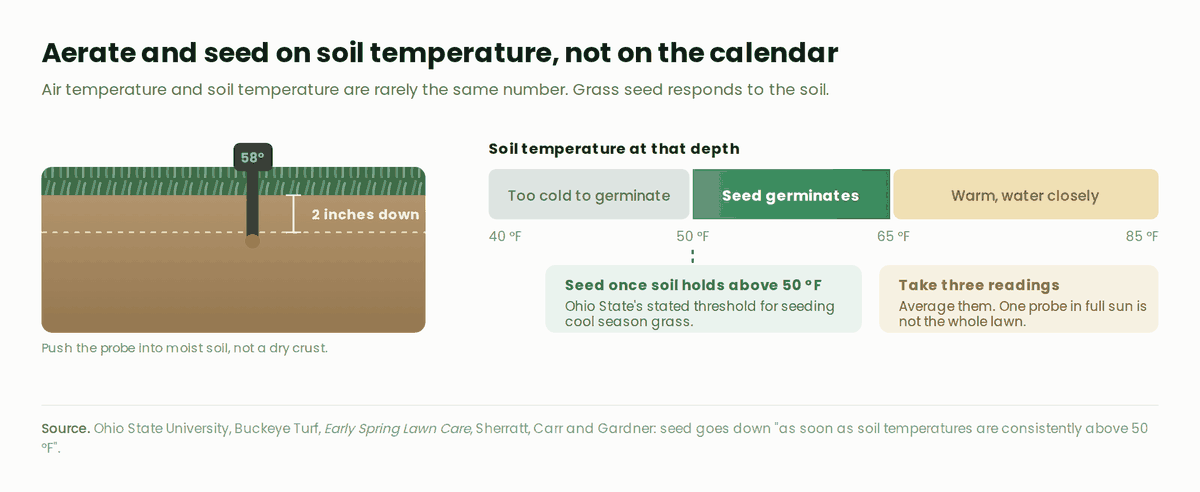
Two inches down, a cheap probe thermometer, three spots in the yard, average them. If you have never checked what your soil is actually made of, a soil test tells you more in one page than a season of guessing. If you are consistently above 50 and heading down from summer highs rather than up from winter lows, you are in the fall window.
Why fall beats spring here
Ohio State’s position is that “typical times to aerate lawns in Ohio are spring and/or fall, when the turfgrass is most actively growing,” and that the operation “is particularly beneficial if it can be done in conjunction with seeding.” So spring is not wrong. It is just more expensive than it looks.
In fall, soil is warm and air is cooling, which is exactly what cool season grass wants. Weed pressure is falling rather than rising. Whatever you seed has autumn plus the following spring to mature before it meets its first real summer.
In spring, the grass you plant gets a few weeks of good growing weather and then walks straight into July. Ohio State notes that Kentucky bluegrass in particular “is slow to establish from seed, which may limit its ability to mature before summer stress.”
The pre-emergent problem nobody warns you about
Here is the part that matters most, and it is the reason spring aeration quietly costs people a season of weed control.
A crabgrass pre-emergent does not kill weeds. It forms a continuous chemical barrier in the top layer of soil that stops seeds from establishing. Purdue Turfgrass Science states the consequence plainly: “for pre-emergents to be effective there must be a continuous herbicide barrier in the soil. Anything that disturbs or ‘breaks’ the barrier may result in poor control or ‘break-through’.”
Core aeration pulls thousands of plugs out of that layer. Every hole is a gap in the barrier.
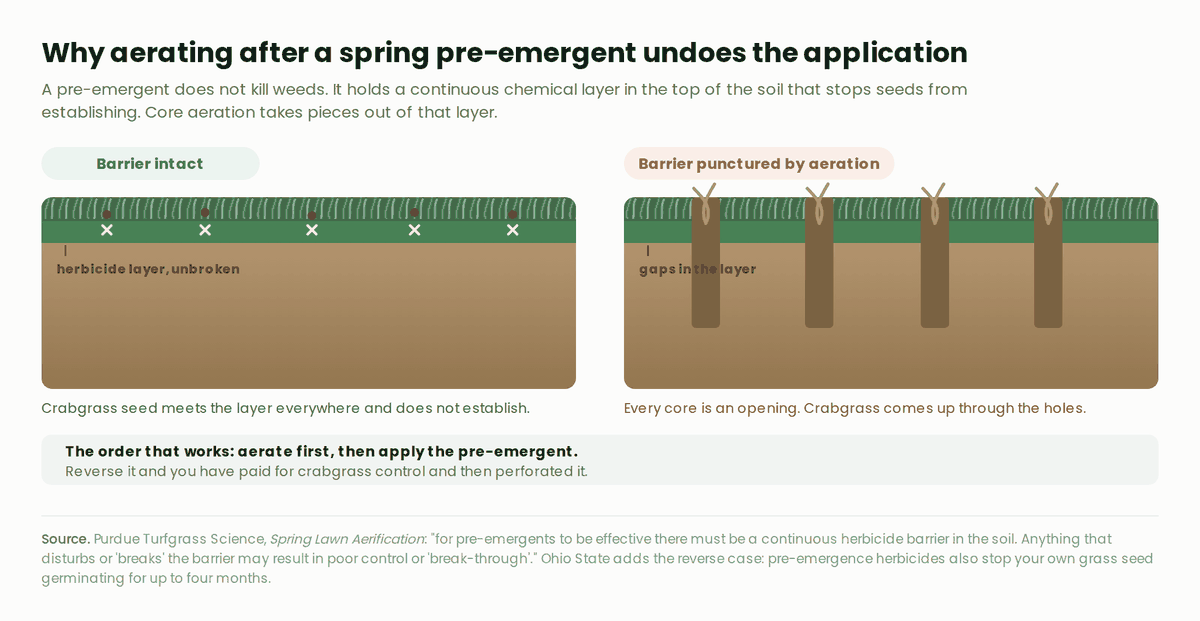
Purdue’s guidance follows from that: “It is best to aerify prior to applying your spring pre-emergent weed and feed products.” Aerate first, apply second. Do it in the other order and you have paid for crabgrass control and then perforated it. The timing of that spring application matters on its own, and we have written separately about when the pre-emergent needs to go down and how the application works.
There is a second version of the same trap on the seeding side. Ohio State warns not to apply pre-emergence herbicides for annual grasses in areas you intend to overseed, “because they will also prevent the germination of our turfgrass for up to four months.” The chemistry cannot tell your grass seed from crabgrass seed. In areas being seeded, Ohio State points to mesotrione applied at the time of seeding as the workable option.
Fall aeration sidesteps this entire conflict, which is a large part of why it is the better default in this region.
How to tell your lawn actually needs it
Aeration is, in Purdue’s words, “a supplementary lawn cultural practice” that is “not necessarily essential to maintaining a lawn, however, it can be very beneficial to most turf areas.” Some lawns need it every year. Some do not.
Signs yours does:
- Water pools or runs off instead of soaking in. Compacted soil has nowhere to put it.
- A screwdriver will not go in. Push a long screwdriver into moist soil. If it stops in the first two inches, the soil is tight.
- Heavy traffic areas are thinning. Paths where people walk, where kids play, where the dog patrols.
- The lawn was built on a construction site. Most subdivision lots had their topsoil stripped and the subsoil driven over by heavy equipment. That compaction does not resolve on its own.
- Thatch is more than half an inch thick. Cut a small wedge and look at the brown layer between green growth and soil.
If several of those describe your lawn, aeration belongs in your treatment program rather than on a someday list.
Do enough holes to matter
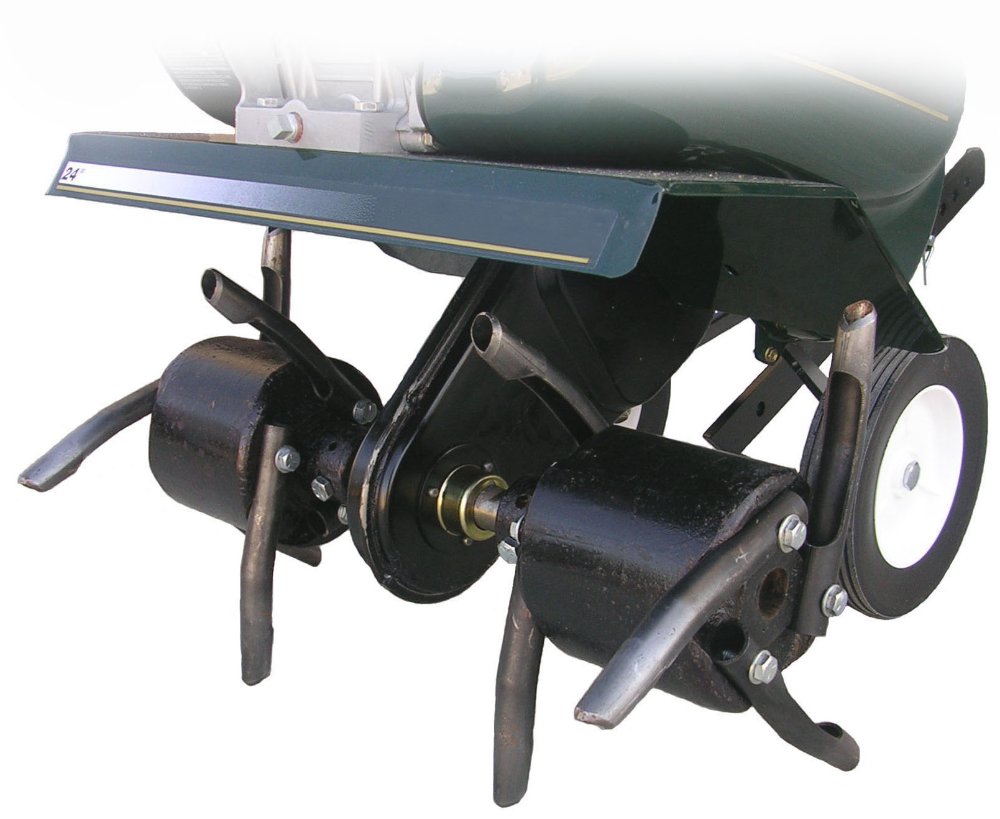
This is where most single-pass jobs fall short. Purdue’s benchmark for recreational turf is to “impact and remove at least 20% of the entire surface annually,” and their note on home lawns is blunt: “one hole per square foot is probably not enough.”
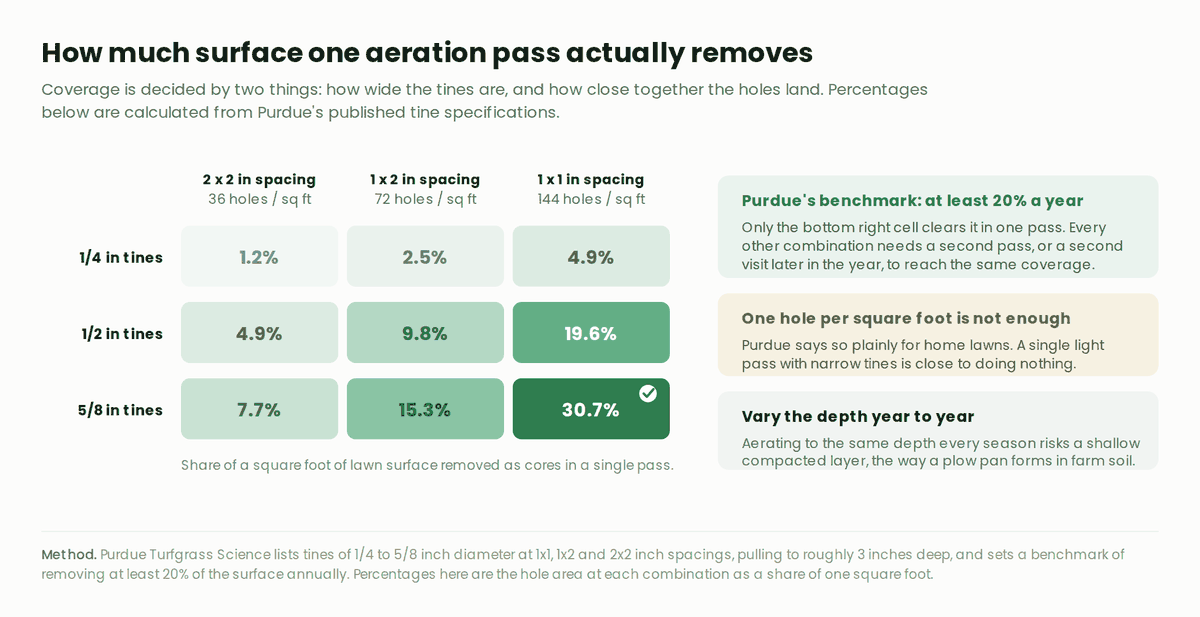
Purdue’s equipment specifications run tines of roughly a quarter inch to five eighths of an inch in diameter, at one by one, one by two, or two by two inch spacings, pulling to around a three inch depth. On a compacted lawn, two passes in a cross pattern is the difference between a treatment and a gesture.
One more detail from Purdue that almost nobody follows: do not aerate to the same depth every single year, because doing so risks “developing a shallow ‘plow-pan’ like agricultural soils.” Vary the depth between seasons.
Get the soil right before the machine arrives
Timing the week is not enough. Timing the soil moisture is what determines whether the tines pull a clean three inch core or bounce off the surface.
Purdue’s late summer checklist asks that “the rootzone is at or near field capacity,” achieved with “several soaking irrigation cycles a few days prior to cultivation.” Not the morning of. A few days before, so moisture has moved down through the profile.
Too dry and the tines skate or pull short, broken plugs. Too wet and, in Purdue’s words, “the tines on the machine may simply become plugged with soil and the full benefits of core removal will not be realized.” The target is soil that a screwdriver enters easily and that does not smear when you squeeze it.
The ten days after matter as much as the day itself
Leave the cores where they fall. Purdue’s guidance is that “it is easiest to simply leave them on the turf surface and allow regular mowing and rain dissolve them back into the turf.” They look untidy for a week or two and then they are gone, having returned soil and microbes to the surface. Raking them up throws away half the benefit.
Then leave the mower alone. Purdue recommends allowing the turf five to ten days to recover before mowing, and raising the cutting height while it does. Ohio State’s mowing guidance is a three to four inch lawn height and never removing more than one third of the leaf tissue in a single cut.
Watch the weather. Purdue notes that “September typically has many crisp, clear, windy days,” which is exactly the combination that dries out an open, freshly punched surface. If you seeded, the seed cannot be allowed to dry. Ohio State is direct about it: “Do not let the grass seed dry out or it will not germinate.” Our watering guidance for Cincinnati and Dayton lawns covers what that looks like week by week.
Aeration and overseeding: the pairing that does the real work
Aeration on its own relieves compaction. Aeration plus seed rebuilds a lawn. It is the one pairing on our calendar that changes a lawn’s baseline rather than maintaining it, which is why it sits in every organic based program we run.
Ohio State names aeration as one of the two large scale methods for preparing a seedbed, alongside a slit seeder, precisely because it creates the seed to soil contact that germination depends on. Seed broadcast onto an aerated surface drops into thousands of open holes, each one a small protected pocket with moisture and contact on all sides. If you are seeding yourself, our walkthrough on how to plant grass and our seeding tips for Cincinnati and Dayton cover the rest of the process.
On species, Ohio State’s read on Ohio conditions is worth quoting. Kentucky bluegrass “is a common choice for lawns in Ohio,” but “tall fescue is becoming much more common in Ohio because of its faster establishment, drought resistance, and tolerance to reduced light in shaded lawns.” For a shaded southwest Ohio yard on heavy soil, that is a meaningful steer.
Fertilize before or after aerating?
After, or at the same time, not weeks before.
The logic is the same as the pre-emergent logic in reverse. Aeration opens channels into the root zone, so nutrients applied to an aerated surface move down to where roots can reach them instead of sitting on top. Ohio State’s published early season rate is 0.5 to 1.0 pounds of nitrogen per 1,000 square feet, with the higher end suited to newly seeded areas and lawns recovering from a hard season, and they are firm that the nitrogen “should primarily be slow-release.”
If you are seeding at the same time, a starter fertilizer at seeding does more than a heavy nitrogen application will. On an organic based program the feeding schedule works a little differently, which we explain in how organic lawn care works.
Doing it yourself versus hiring it out
An honest comparison, because the answer is not always hire someone.
Renting makes sense if your lawn is small and flat, you can get a heavy machine off a trailer and back on, and you can commit a full Saturday. A rental aerator is heavy, awkward on slopes, and genuinely hard on your back and forearms.
Hiring makes sense if the lawn is large, sloped, or compacted enough to need two passes, if you want aeration and overseeding timed together as part of a full season program, or if you want the irrigation and utility lines marked before anything with three inch tines crosses them. It is also the honest answer if the alternative is a rental that sits unused because the weekend got away from you, which happens more often than anyone admits.
The thing that decides the outcome is not who runs the machine. It is whether it happens inside the window, on soil at the right moisture, with enough passes to actually move the coverage number.
Southwest Ohio soil, specifically
Southwest Ohio does not have one soil, which is why aeration advice written for the state as a whole tends to miss.
The Cincinnati side sits largely on silty, clay rich soils over shale and limestone. Clay holds water and compacts readily, particularly on graded subdivision lots where the original topsoil was stripped during construction. These are the lawns where water sheets across the surface after a storm and where a screwdriver stops short. They are also the lawns that gain the most from a genuine two pass job. It is the pattern we see most often on the older Cincinnati side of the map, in Indian Hill, Madeira, Kenwood and Dry Run.
The Miami Valley on the Dayton side is different. River terraces along the Great Miami carry outwash sand and gravel, which drain quickly and compact less, sitting alongside heavier till soils elsewhere in the same neighborhood. A lawn on outwash may need aeration less often but will need water more attentively after seeding, because the same drainage that prevents compaction also pulls moisture away from new seed. You can see how we approach each area on our service area pages, including Montgomery, Blue Ash and Wyoming.
Common questions
What are the signs my lawn needs aeration?
Water pooling or running off, a screwdriver that will not push into moist soil, thinning in high traffic paths, more than half an inch of thatch, or a lawn on a graded construction lot.
Is now a good time to aerate in Ohio?
If it is between mid August and late September and soil temperature is above 50 degrees, yes. After the third week of October, wait for spring.
Should I fertilize before or after aeration?
After, or at the same time. Aeration opens the path for nutrients to reach the root zone.
When should I not aerate my lawn?
In midsummer heat, when soil is either bone dry or saturated, on a lawn seeded within the last year, and in spring after a pre-emergent has already been applied.
Can I aerate and seed on the same day?
Yes, and that pairing is where most of the value is. Ohio State specifically notes aeration is particularly beneficial done alongside seeding.
Getting it done inside the window
The window in southwest Ohio is short, roughly five weeks, and it closes on the calendar whether or not the weekend cooperates. If you would rather have it timed against soil temperature and paired properly with seed, get in touch and we will look at your lawn, or read what is included in our lawn treatment programs first.
Sources
- Ohio State University, Buckeye Turf, Early Spring Lawn Care, Pam Sherratt, Tyler Carr PhD and David Gardner PhD, March 2025.
- Purdue University Turfgrass Science, Spring Lawn Aerification.
- Purdue University Turfgrass Science, Late-summer Aerification Check-List.
- Purdue University Extension, Now is the Time to Improve your Home Lawn.
- NOAA National Weather Service, Wilmington Ohio forecast office, fall frost and freeze climatology, 1991 to 2020 normals.