
Dayton Aviation Heritage National Historical Park
Dayton, Ohio occupies a singular position in the history of human flight — it is the city where Wilbur and Orville Wright were born, raised, and conducted the foundational research that made powered aviation possible. The Dayton Aviation Heritage National Historical Park preserves the physical locations and historical artifacts associated with the Wright Brothers’ lives and work in Montgomery County, along with the literary legacy of Paul Laurence Dunbar, the African American poet whose life intersected with the Wrights’ in Dayton’s late nineteenth century West Side neighborhood.
Administered by the National Park Service, the park encompasses multiple non-contiguous sites across Dayton that together document a concentrated period of American genius that transformed the world. For Dayton residents, Montgomery County families, and anyone tracing the origins of the aviation age, the park offers one of the most intellectually rewarding heritage experiences in the American Midwest.
The Park’s Origins and the Wright Brothers’ Dayton Claim
The park’s establishment in 1992 reflected a growing national recognition that Dayton’s claim to the Wright Brothers’ story was as legitimate as Kitty Hawk’s — and in many respects more so, since the brothers conducted years of foundational bicycle shop experimentation, wind tunnel research, and design iteration in Dayton before making the brief powered flights in North Carolina that history has immortalized.
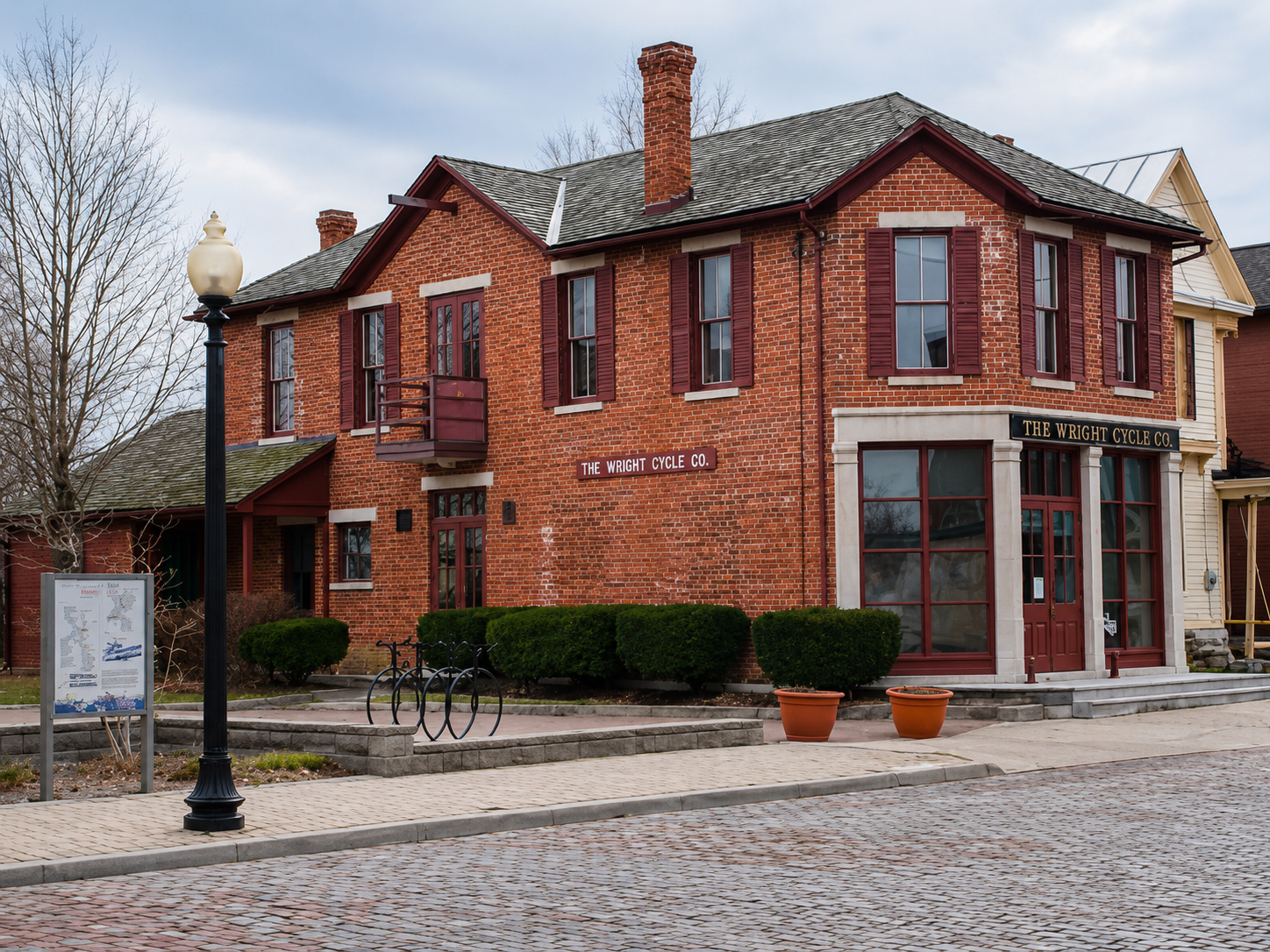
The bicycle shop at 22 South Williams Street where Orville and Wilbur designed and built their early gliders and the 1903 Flyer, the Wright Cycle Company building, and Huffman Prairie Flying Field where the brothers developed practical controlled flight in 1904 and 1905 all sit within the park’s boundaries — a collection of sites whose combined significance exceeds what any single location could convey alone.
The Oregon District — Dayton’s oldest historic neighborhood just north of downtown — reflects the same late nineteenth century urban character that shaped the West Side neighborhood where the Wright Brothers and Paul Laurence Dunbar came of age.
The Wright Cycle Company and West Third Street Sites
The Wright Brothers’ Dayton story is inseparable from the bicycle business that funded their aviation research and the West Third Street commercial corridor where their shops operated during the critical years of their flying machine development. The Wright Cycle Company complex preserved within the park includes the bicycle shop building where the brothers worked — a modest wood-frame commercial structure whose physical character reflects the resourcefulness and mechanical ingenuity that defined the Wrights’ approach to engineering challenges.
The building’s survival into the twenty-first century is itself a preservation story, having been moved from its original location and carefully maintained as the most tangible physical artifact of the Wrights’ Dayton working environment.
The Dayton Aviation Heritage National Historical Park — administered by the National Park Service — provides visitor information, interpretive programming, and access to the multiple park sites that collectively document the Wright Brothers’ Dayton years.
The park’s interpretive approach emphasizes the methodical, iterative character of the Wrights’ research process — the hundreds of glider tests, the wind tunnel experiments, the careful documentation and revision that distinguished their engineering approach from the more intuitive methods of their contemporaries and that ultimately produced the first successful powered aircraft.
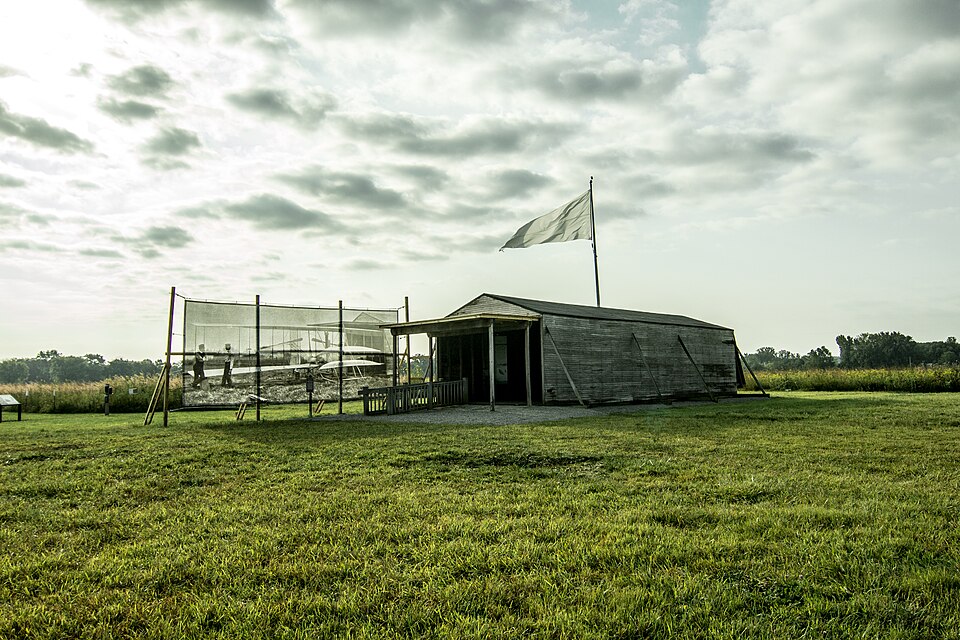
Image Credit: Ismael Laos, CC BY-SA 4.0, via Wikimedia Commons
Huffman Prairie Flying Field and the Development of Practical Flight
Huffman Prairie Flying Field, located on the grounds of Wright-Patterson Air Force Base east of Dayton in Greene County, represents a site of aviation significance that in many respects exceeds even Kitty Hawk in its historical importance.
The brothers conducted more than 100 flights at Huffman Prairie during 1904 and 1905, developing the controlled banking turns, sustained circular flight patterns, and pilot control techniques that transformed their December 1903 North Carolina achievement from a brief demonstration of powered flight into a practical, controllable flying machine. This methodical development work — invisible to the public, conducted on a leased farm field outside Dayton, and largely unwitnessed by journalists — represents the true engineering breakthrough that made aviation a viable technology rather than a laboratory curiosity.
The Huffman Prairie site preserves the original flying field where this development work occurred, along with the reconstructed hangar that housed the Wrights’ aircraft during their Dayton flying seasons. The field’s location within the active Wright-Patterson Air Force Base perimeter — connecting the Wrights’ civilian aviation research to the military aviation complex that followed in their wake — reinforces the thematic continuity between Dayton’s aviation heritage and its contemporary identity as a center of aerospace research and development.
Paul Laurence Dunbar and the Park’s Literary Dimension
The Dayton Aviation Heritage National Historical Park’s inclusion of the Paul Laurence Dunbar State Memorial within its boundaries reflects a deliberate interpretive decision to connect the Wright Brothers’ technological achievement to the broader cultural and intellectual life of late nineteenth century Dayton. Dunbar, born in Dayton in 1872 to formerly enslaved parents, became one of the first African American poets to achieve national recognition, publishing twelve volumes of poetry and six novels before his death at age 33.
His friendship with Orville Wright dated to their shared years at Dayton Central High School, and the two men’s parallel trajectories — each achieving extraordinary national recognition in their respective fields from the same West Side Dayton neighborhood — give the park’s interpretive program a cultural depth that a purely aviation-focused site could not provide.
The Dunbar House, a Queen Anne-style residence at 219 North Summit Street that Dunbar purchased for his mother in 1904, preserves the poet’s personal library, manuscripts, and domestic environment in the last years of his life. The Ohio History Connection manages the Dunbar House as part of its statewide network of historic sites, providing visitors with access to a significant figure in American literary history whose Dayton roots are inseparable from the neighborhood that also produced the Wright Brothers. The University of Dayton — located just south of the park’s West Side sites — continues this tradition of intellectual and civic achievement that has long defined Dayton’s identity as a city that values both technical innovation and cultural contribution.
Ohio’s Climate and the Park’s Year-Round Visitor Experience
Ohio’s climate shapes the visitor experience at the Dayton Aviation Heritage National Historical Park in specific and practical ways — particularly at the outdoor sites like Huffman Prairie Flying Field where the original aviation experiments occurred on an exposed farm field subject to the full range of Montgomery County’s weather conditions. Dayton experiences a humid continental climate — with hot, humid summers averaging July highs near 84°F, cold winters with average January lows near 20°F, and approximately 38 inches of annual precipitation according to NOAA climate data for Dayton.
These climate conditions — particularly the variable winds and open sky of the Miami Valley — were factors the Wright Brothers themselves considered when selecting Huffman Prairie as their primary flying field after Kitty Hawk.
The park’s indoor sites — the Wright Cycle Company complex and the Dunbar House — provide climate-controlled visitor experiences that remain accessible year-round regardless of Dayton’s seasonal weather extremes. Spring and fall bring the most comfortable conditions for exploring the outdoor Huffman Prairie site, when Montgomery County’s weather is most reliably mild and the field’s open landscape is at its most visually inviting. Summer heat and winter cold compress the most comfortable outdoor visiting windows but never fully close the park to visitors who plan their timing appropriately.
The Park’s Role in Dayton’s Civic and Cultural Identity
The Dayton Aviation Heritage National Historical Park occupies a central position in the city’s civic identity — a federally recognized acknowledgment that Dayton’s contribution to human history is of national and global significance rather than merely local pride.
The park’s existence has reinforced Dayton’s sustained investment in aviation heritage institutions, including the National Museum of the United States Air Force at Wright-Patterson Air Force Base, which together give Montgomery County the most concentrated collection of aviation history resources of any metropolitan area in the United States.
For Dayton residents navigating a city that has faced significant economic and demographic challenges since the decline of its manufacturing base, the park represents a source of civic pride grounded in genuine historical achievement rather than nostalgic mythology.
The Wright Brothers’ story — two bicycle mechanics from a modest West Side neighborhood who solved one of the defining technical challenges of the modern era through patience, rigor, and methodical experimentation — carries a particular resonance for a city that has always defined itself through the quality of its making. Those exploring the history, culture, and community character of Dayton Ohio will find that the Aviation Heritage National Historical Park remains the most compelling single expression of what this city has contributed to the world.