

Why Fall Is the Best Time to Seed a Lawn in Southwest Ohio
In southwest Ohio, the best time to seed a cool season lawn is late summer into early fall, roughly August 15 to September 15, with results falling off steadily after that. Warm soil, cooling air, fewer weeds and months of root growth before the next summer are what make fall seeding work, and spring seeding rarely gets all four.
This guide covers why the fall window works, how the average first freeze in Cincinnati and Dayton sets the real deadline, what goes wrong with spring seeding, which seed to buy, and the watering schedule that decides whether any of it comes up.
Jump to: The window · The freeze deadline · Why fall beats spring · Choosing seed · Preparing the soil · Watering schedule · The first eight weeks · If the window has passed · FAQ
The seeding window for Cincinnati and Dayton
Purdue University’s turfgrass program puts it simply: “Normally, we recommend seeding between August 15 and September 15 as the optimum seeding window.” The University of Kentucky, whose guidance covers the lawns just across the river from Cincinnati, gives a slightly wider range: “The best time to seed cool-season grasses such as Kentucky bluegrass or tall fescue is from mid-August to late September.”
Southwest Ohio sits between those two programs, so both windows apply. The practical reading is that seed sown in the second half of August or the first half of September has the best odds, and seed sown later is still possible but works against a shrinking clock.
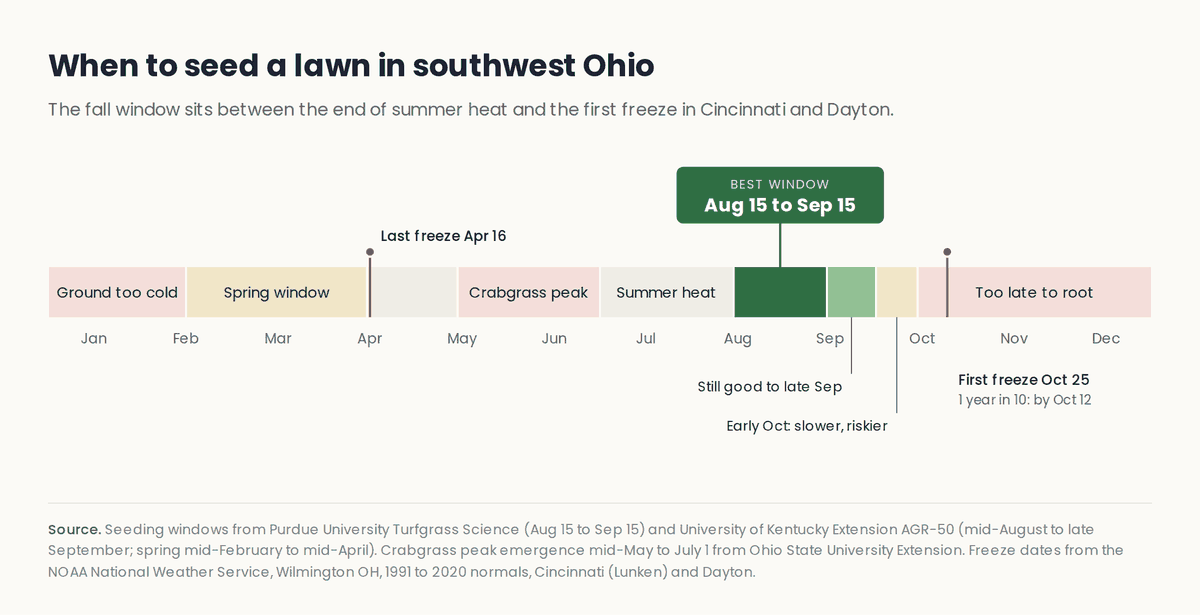
Kentucky’s guidance also names a secondary spring window, “from mid-February to mid-March but not later than mid-April.” It exists, and it is covered below, but it carries costs that the fall window does not.
The freeze sets the real deadline
The calendar dates above are general. The local deadline comes from the weather. The National Weather Service office in Wilmington, which covers both cities, lists the normal first fall freeze (32°F) as October 25 at Cincinnati’s Lunken Airport station and at Dayton’s airport station, based on 1991 to 2020 records. One year in ten, that freeze arrives by October 12 in Cincinnati and October 13 in Dayton.
Counting forward from the seeding date to those two freeze dates shows how quickly the margin disappears:
| Seed sown on | Days until the average first freeze (Oct 25) | Days until an early freeze year (Oct 12) |
|---|---|---|
| August 15 | 71 | 58 |
| September 1 | 54 | 41 |
| September 15 | 40 | 27 |
| October 1 | 24 | 11 |
| October 15 | 10 | none |
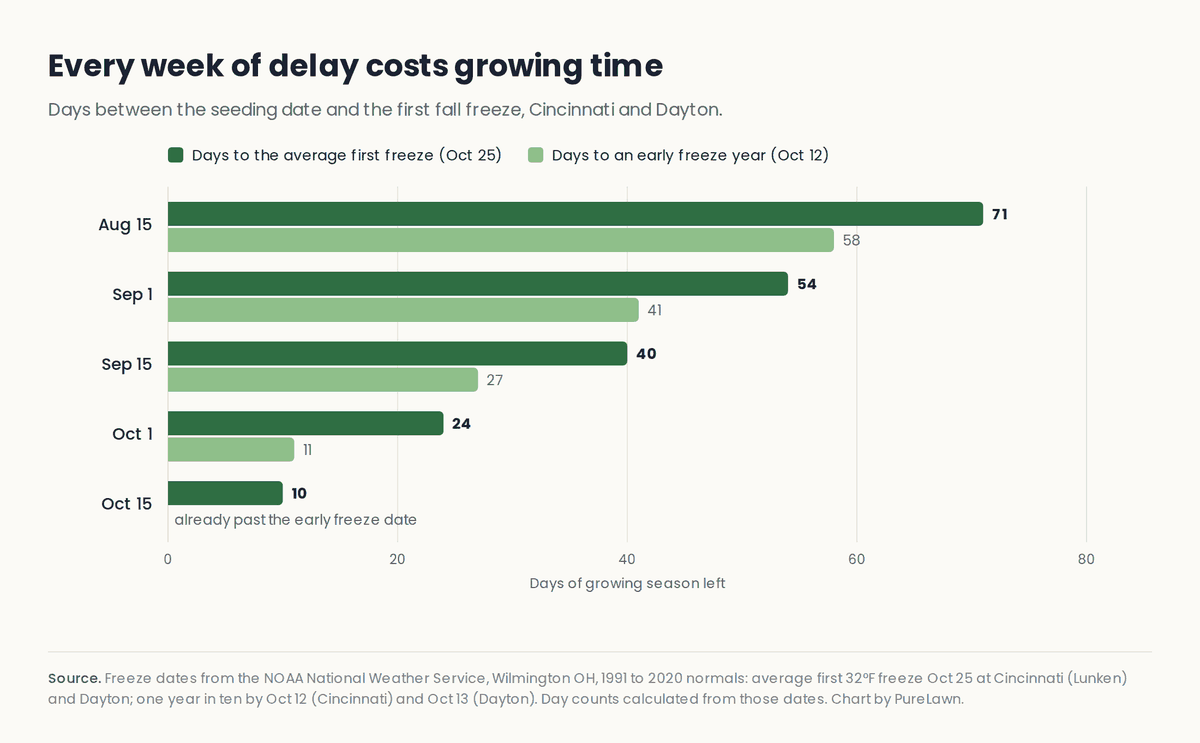
A first freeze does not stop all growth, and cool season grass keeps rooting in cool fall soil. The point is that the delay compounds. Purdue’s Aaron Patton notes that “waiting one week later to seed may mean the turf will take 2 more weeks to mature as germination and subsequent growth slows later in the fall.” A September 1 seeding and an October 1 seeding are not four weeks apart in outcome. They are closer to two months apart.
Why fall seeding beats spring seeding
The University of Kentucky lists the reasons fall works: “cooling temperatures, fall rains, no competition from crabgrass or goosegrass, and 7 to 8 months of root development and maturation before the summer stress period.” Each of those is worth unpacking, because each one is something spring seeding lacks.
Warm soil, cooling air
Seed germinates on soil temperature, not air temperature. Ohio State’s turfgrass team advises seeding “as soon as soil temperatures are consistently above 50 °F.” In late summer the soil is well above that and still holding summer heat, while the air is cooling toward the range cool season grass prefers. Purdue describes the result as “adequate soil moisture, warm soil, and limited weed pressure” that “allow for excellent seedling growth.” In spring the order is reversed. The air warms first and the soil lags behind, so seed sits waiting in cold ground.
Less weed competition
Crabgrass is a summer annual. Ohio State Extension reports that smooth crabgrass begins emerging once the top inch of soil reaches 54°F for seven days, with peak emergence “from mid-May to July 1st.” A spring seeding comes up at exactly the moment crabgrass does. A late summer seeding comes up as crabgrass is finishing its season. Identifying what does come up is easier with the guide to common Ohio lawn weeds.
The pre-emergent conflict
Spring seeding also collides with crabgrass control. Ohio State warns against applying pre-emergence herbicides for annual grasses in areas that will be overseeded, “because they will also prevent the germination of our turfgrass for up to four months.” Kentucky’s guidance notes that spring seedings depend on herbicides to manage crabgrass competition, and the choice of product matters. A homeowner seeding in April usually has to choose between protecting the seed and protecting the lawn from crabgrass. The same conflict is behind the timing advice in the guide to aerating a lawn in Ohio, and it is why crabgrass control is planned around seeding rather than the other way round.
Time to root before summer
This is the largest difference. Grass seeded on September 1 has about 290 days before the first day of summer. Grass seeded on April 16, the normal date of the last spring freeze in both cities, has about 66. Ohio State notes that Kentucky bluegrass in particular “is slow to establish from seed, which may limit its ability to mature before summer stress.” Spring seedings often look fine in May and thin out in July, when heat and dry weeks find a root system that never had time to go deep.
Choosing seed for a southwest Ohio lawn
Ohio State Extension names four species suited to Ohio lawns: Kentucky bluegrass, perennial ryegrass, tall fescue and fine fescue. Ohio State’s turfgrass team adds that tall fescue “is becoming much more common in Ohio because of its faster establishment, drought resistance, and tolerance to reduced light in shaded lawns.”
- Turf type tall fescue suits most sunny to partly shaded lawns on heavy soil. Ohio State’s establishment series lists a seeding rate of 8 to 10 pounds per 1,000 square feet.
- Kentucky bluegrass spreads to repair itself and has good cold tolerance, but establishes slowly. The listed rate is 2 to 3 pounds per 1,000 square feet.
- Perennial ryegrass “establishes quickly,” which makes it useful in blends and for patching. The listed rate is 7 to 8 pounds per 1,000 square feet.
- Fine fescues are the shade specialists, at 3 to 6 pounds per 1,000 square feet.
Ohio State also recommends blending “two to four cultivars” within a species for better disease and insect resistance. The simplest rule for overseeding is to match the grass already in the lawn. If the existing lawn is a mix, a turf type tall fescue blend is the common choice in this region.
Reading the seed tag
Every bag carries a label, and Purdue Extension publishes the numbers worth checking before buying:
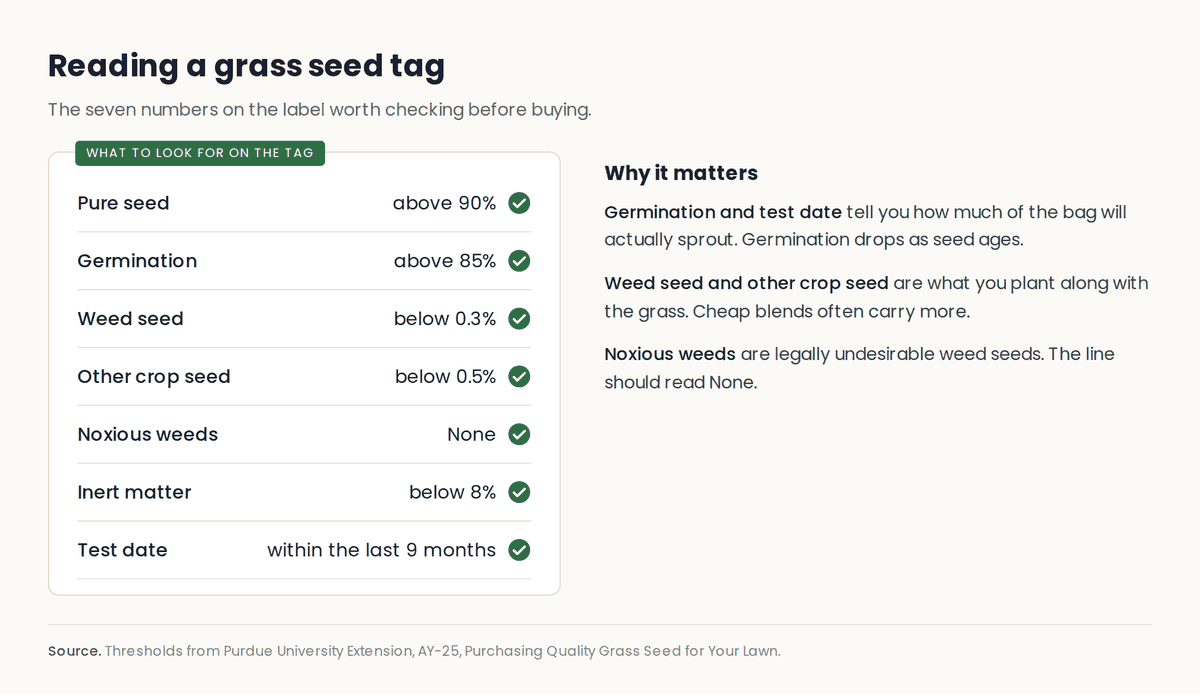
- Pure seed above 90 percent
- Germination above 85 percent
- Weed seed below 0.3 percent
- Other crop seed below 0.5 percent
- Noxious weeds: none
- Inert matter below 8 percent
- Test date within the last 9 months
The test date matters more than most people expect. Germination falls as seed ages, which is covered in more detail in does grass seed go bad. The seeding tips for Cincinnati and Dayton lawns also list which cheap blends to avoid, including annual ryegrass and older forage type tall fescue.
Preparing the soil so seed can reach it
Seed that sits on top of thatch or hard clay rarely establishes. Ohio State names aeration and slit seeding as the two large scale ways to get seed into contact with soil, and Kentucky’s guidance recommends a soil test before planting, with any recommended fertilizer worked into the top 4 to 6 inches on bare ground.
- Small patches: loosen the surface with a metal rake, spread seed evenly, then rake again so it is mixed into the top layer. The step by step version is in how to plant grass and how to plant grass seed.
- Thin whole lawns: core aeration followed by broadcast seeding drops seed into thousands of open holes. Slice seeding cuts grooves and places seed directly in them.
- Dog spots and worn paths: the same process on a small scale. The guide to dog urine spots covers patching those areas.
The University of Minnesota suggests spreading seed at half rate in two perpendicular directions, which evens out coverage and avoids stripes.
The watering schedule for new grass seed
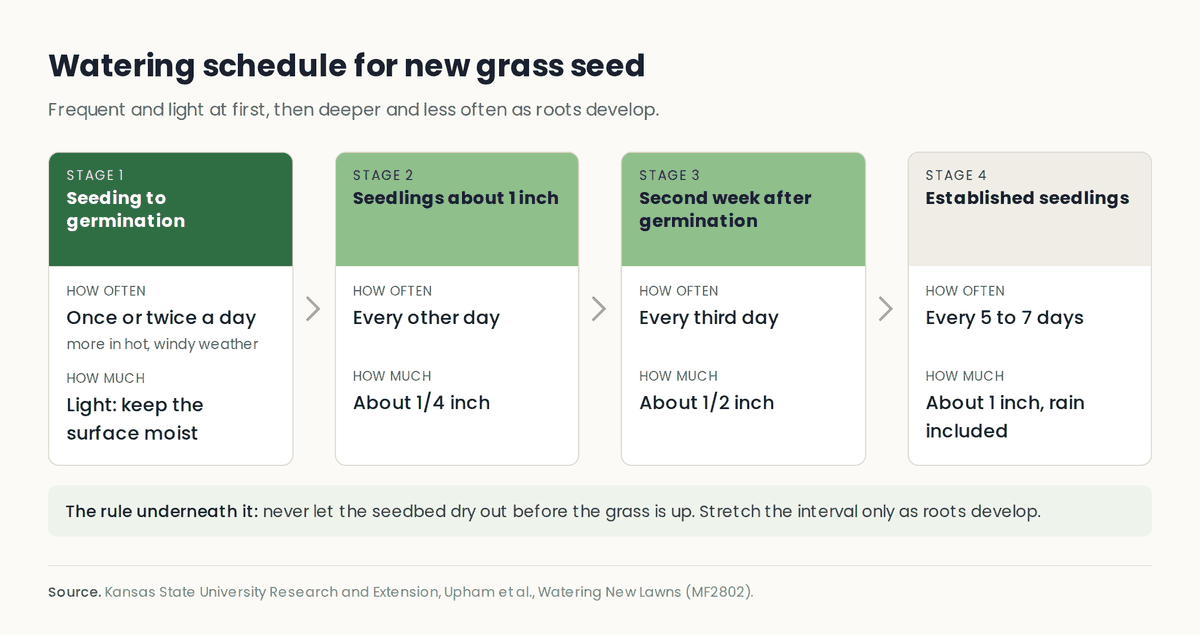
Watering decides whether a seeding succeeds more than any other step. The seed must stay moist from the day it goes down until it germinates, and a single dry afternoon can kill seedlings that have just sprouted. Kansas State University’s extension publication on watering new lawns gives a staged schedule, shown below with its source figures.
| Stage | How often | How much |
|---|---|---|
| Seeding to germination | Once or twice a day, more in hot or windy weather | Light, just enough to keep the surface moist |
| Germination complete, seedlings about 1 inch tall | Every other day | About 1/4 inch |
| Second week after germination | Every third day | About 1/2 inch |
| After that | Every 5 to 7 days | About 1 inch, including rain |
A few practical points make the schedule work:
- Keep the surface moist, not flooded. Kentucky’s guidance warns against watering to the point of standing water, which washes seed into low spots.
- Water in the morning and again early afternoon on warm, breezy days. September wind dries a bare seedbed fast.
- Count rain. A soaking rain replaces that day’s watering. A rain gauge or an empty tuna can on the lawn shows how much fell.
- Measure the sprinkler once. Set a few straight sided cans in the spray pattern and time how long it takes to collect 1/4 inch. That time becomes the run time for the second stage.
Germination is not instant. Ohio State describes perennial ryegrass as quick to establish and Kentucky bluegrass as slow, so a bluegrass blend can look like nothing is happening for the first couple of weeks. That is normal, and it is the reason to keep watering through the quiet period.
The first eight weeks after seeding
- First mowing: Kentucky’s guidance is to mow when new grass reaches about one third taller than the target height. For a 3 inch lawn, that means mowing at about 4 inches, with a sharp blade and dry grass.
- Feeding: Kentucky advises holding additional fertilizer until seedlings are about 1 inch tall and rooted.
- Weed control: Hold off on broadleaf weed sprays in new grass. The common lawn questions page suggests waiting until new grass has been mowed three times before spot spraying.
- Leaves: Fallen leaves block light from young grass. Rake or mulch them lightly and often rather than letting a mat build up.
- Traffic: Keep people and pets off seeded areas as much as possible until the new grass has been mowed a few times.
Purdue also points out a downside of seeding late in fall: compared with late summer seeding, it increases problems with annual bluegrass and winter annual weeds. That is one more reason the front half of the window is worth the effort.
If the window has already passed
Seed sown in the first days of October in southwest Ohio can still come up, especially in a mild fall, but it has less than half the growing time of an early September seeding and it needs close watering. Past mid October, the better options are to wait for next August or to seed dormant.
Dormant seeding means spreading seed once soil is too cold for it to germinate, usually late fall into winter, and letting freezing and thawing work it into the soil so it comes up in spring. It skips most of the watering but gives up spring crabgrass pre-emergent on those areas. The trade offs are laid out in winter dormant seeding and what is winter seeding.
Frequently asked questions
When should I plant grass seed in Ohio?
Late summer to early fall. Purdue’s optimum window is August 15 to September 15, and the University of Kentucky extends it to late September. In southwest Ohio, where the average first freeze is October 25, earlier in that range is better.
Is it too late to plant grass seed in October?
Early October seedings can work with careful watering, but the average first freeze leaves only about three weeks of growing time from October 1, and growth slows as soil cools. After mid October, dormant seeding or waiting for late summer is the better choice.
Can I plant grass seed in the spring in Ohio?
Yes, but results are less reliable. Spring seedings compete with crabgrass, cannot use most crabgrass pre-emergents, and have only a couple of months to root before summer heat. Kentucky’s spring window runs from mid February to mid March and not later than mid April.
How often should I water new grass seed?
Once or twice a day, lightly, until it germinates, then every other day at about 1/4 inch, then every third day at about 1/2 inch, then about 1 inch every 5 to 7 days. That is the Kansas State University schedule.
What is the best grass seed for Ohio?
For most sunny to partly shaded lawns in southwest Ohio, a turf type tall fescue blend. Kentucky bluegrass suits lawns already built on bluegrass, and fine fescue suits heavy shade. Check the tag for germination above 85 percent and a recent test date.
Getting fall seeding done in Cincinnati and Dayton
PureLawn recommends fall seeding every year until a lawn is thick, and schedules core aeration with overseeding and slice seeding through September and into mid October for lawns across the Cincinnati and Dayton areas. Seeding can also be added to any of the lawn treatment programs.
Service areas include Blue Ash, Montgomery, Kenwood, Madeira, Indian Hill, Wyoming, Dry Run and the wider Cincinnati and Dayton region. To get seed down while there is still time, contact PureLawn or call (937) 703-1221.
Sources
- Purdue University Turfgrass Science, Aaron Patton, Start Seeding Cool-Season Turf Now.
- University of Kentucky Cooperative Extension, AGR-50: Lawn Establishment in Kentucky.
- NOAA National Weather Service, Wilmington OH, Fall Frost and Freeze Climatology and Spring Frost and Freeze Climatology, 1991 to 2020 normals.
- Ohio State University Extension, Jeff Stachler, Managing Crabgrass in Turf.
- Ohio State University, Buckeye Turf, Pam Sherratt, Tyler Carr and David Gardner, Early Spring Lawn Care, March 2025.
- Ohio State University Extension, Nangle, Gardner, Pound and Street, Lawn Grass Cultivar Selection (HYG-4027).
- Ohio State University, Buckeye Turf, Maranda Berger, Turfgrass Establishment Series: Species and Cultivar Selection.
- Purdue University Extension, AY-25: Purchasing Quality Grass Seed for Your Lawn.
- Kansas State University Research and Extension, Upham et al., Watering New Lawns (MF2802).
- University of Minnesota Extension, Seeding and Sodding Home Lawns.